How to Train Chess Calculation With a Timer
Calculate with the pieces still. Record your line, replay the hardest reply, and identify where your thinking went off course.
To train chess calculation with a timer, pick one position, set a time limit, and think through your line without moving the pieces. Write down your first move, the opponent’s strongest reply, and what you expect the position to look like afterward. Then play the line and identify the first place your prediction diverged from the board.
Start with about two minutes on one unfamiliar position. Try one minute when you can reach a clear result consistently, or give yourself three minutes when the opponent has several serious replies. These are training choices. After the clock stops, take the time you need to review.
How to run a timed calculation drill
- Start from a fresh board. Check who moves first and whether that king is in check. Give yourself a specific job, such as finding mate in two, holding an ending, or comparing two ways to capture.
- Calculate with the pieces in place. Pick a promising move, give the opponent a strong reply, and follow the branch until you can assess what happened. If two replies do different things, calculate them separately from the original position.
- Commit to what you actually saw. At the end of the time, record the line and how you evaluated it. If you had an incomplete line, write down its last reliable move. That makes it possible to tell where the calculation stopped.
- Replay and name one correction. Check the opponent’s replies and the resulting board. Mark whether you missed a candidate, a reply, a square, a move order, or the final evaluation. Try the same correction on a fresh position.
Give yourself enough time to write a coherent first attempt. If every clock expires before you find a candidate, try a simpler position or a longer clock. If you finish with time left, use it to look for a reply you dismissed too quickly. In the mate exercise below, one Black reply takes the queen. Two others move the king. The fact that your first branch works tells you what to test next.
A 12-minute first session
Take three unfamiliar positions. Allow two minutes to calculate each and start with two minutes for each review. A short review is enough when you can point to the missed move. If you still can’t explain the mistake at the end of the session, keep that position for a longer review.
On the first board, spend the opening part of the clock choosing what to calculate. In a mate exercise, list the legal checks and look for a reason to reject each. Once you have a candidate that survives the first test, give the other side all the captures, blocks, and king moves that answer the check. On a pawn race, count the promotion turns, then use your remaining time to check the two queens’ lines.
Keep the clock the same across a set of similar positions so you can compare your notes. One minute works as a shorter trial after you can finish the line at two. Three minutes gives you time to check more than one meaningful branch. The longer clock earns its place when you can show what you verified with the extra time.
Do the drill away from any ongoing game. For practice with your own decisions, wait until the game is complete, then reopen the position before the move. Keep the board, your original game move, and the line you calculated today in the same record. How to review a completed chess game
Play the timed calculation exercises
Try Mate in two first. Choose a duration and start the clock, or calculate without it. Record your line before playing the move. Then use the moves that appear beside the board to check it. In Pawn race, predict what happens after both promotions. Try Race with a blocker once you have a first answer.
The board couldn’t load. The diagrams, written solutions, and practice card are below.
White to move. Find mate in two against every reply.
Select a piece and destination or drag to move. With a keyboard, use the arrow keys and Enter.
Exercise 1. Calculate mate against three replies
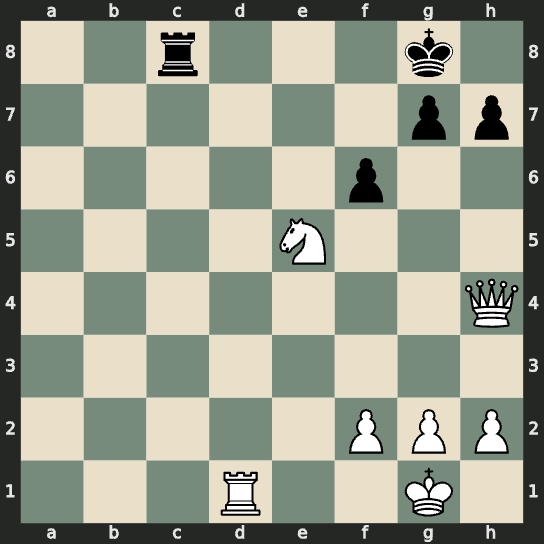
Look at what Black can do to your first check. Is a capture possible? Can the king move to a square that changes which of your pieces can deliver mate? Keep track of which piece is still on c8 each time you switch branches.
Show the three mating lines
1.Qc4+ forces mate on White’s next move. After 1…Rxc4, the rook leaves the eighth rank. White’s rook can now play 2.Rd8#. If Black instead plays 1…Kh8, the rook is still on c8. White can take it with 2.Qxc8#. After 1…Kf8, the mate is 2.Qf7#, with White’s knight on e5 protecting f7.
Compare two checks that fail. After 1.Qxh7+ Kxh7, White has lost the queen because no piece protects h7. After 1.Rd8+ Rxd8, Black simply takes the rook off the board. Those captures explain why checking the king early is helpful when you search, and why you still have to see the reply before choosing a check.
If you wrote 1.Qc4+ Rxc4 2.Rd8# and left out both king moves, you found the first move and one complete line. Mark “missed a reply” so you can practise listing escapes after your next candidate check. If you saw all three replies but put the white queen on the wrong starting square in one branch, record that as a board-visualization error.
Writing in coordinates is fine. For the first branch you could write “queen h4–c4, rook c8–c4 takes, rook d1–d8 mate.” For a new branch, restart at the moment just after Qc4+. Put the black rook back on c8 and the white queen back on c4 in your mind. After the king moves to h8, the queen can now travel from c4 up the c-file to take the rook. Resetting to the branch point prevents the board from one variation leaking into another.
If time ends before you reach the finish, record the reliable part. “Qc4+, …Kf8, then I lost track of which squares the knight covers” gives you a precise place to restart. You can then identify f7 as a square the knight on e5 protects. That is a more useful correction than writing down that the whole puzzle was too hard.
Exercises 2 and 3. Follow the pawn race past promotion
White’s pawn on a6 and Black’s pawn on h3 both need two moves to promote. White moves first. Before choosing a move, name the square on which each pawn will promote. Then ask whether the player who promotes second gives check and what the first queen can do about it. Run the same process with the added pawn on d5.
Show how the d5-pawn changes the result
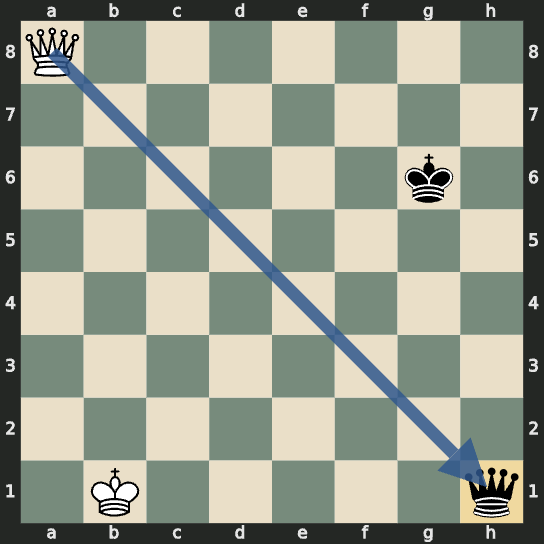
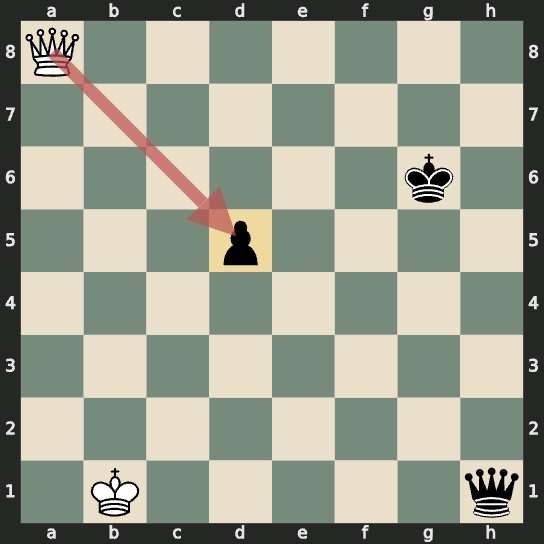
In the first race, calculate 1.a7 h2 2.a8=Q h1=Q+ 3.Qxh1. The black queen gives check along the first rank, but White can take it. Trace a8–b7–c6–d5–e4–f3–g2–h1 on the board. The diagonal is clear. White wins with queen and king against king.
Try spending the first turn on 1.Kc2?. With 1…h2 2.a7 h1=Q 3.a8=Q Qxa8, the same clear diagonal helps Black. Black placed a queen on it first and has the move as soon as White promotes. That is a move-order error if you saw the diagonal but gave the wrong player the first capture.
Add Black’s pawn on d5. After the same 1.a7 h2 2.a8=Q h1=Q+, 3.Qxh1 is illegal because the pawn blocks the queen. One reply is 3.Kc2, and Black can continue with 3…Qe4+. In this position, the same pawn also blocks Black’s queen from capturing back up that diagonal if White plays Kc2 first. Both 1.a7 and 1.Kc2 can hold the draw with correct play.
The four-piece position is a tablebase win for White, with a7 the only winning first move. The five-piece position with the pawn on d5 is a tablebase draw. In a game, judge who can force a useful follow-up after promotion. Counting queens or promotion turns only gets you part of the way. Lichess tablebase documentation
How to log the calculation error
Compare the line you recorded with the moves you actually replayed. Start at the first mismatch. A later mistake can be a consequence of an earlier one. For example, forgetting the pawn on d5 changes whether Qxh1 is legal. It also changes your evaluation of the whole ending. The earlier mistake gives you the more specific thing to practise.
- Candidate
- “I checked on h7 and never examined Qc4+.” Next time, list your legal checks before comparing two promising ones.
- Reply
- “I saw the rook capture but missed …Kf8.” Next time, check king moves, blocks, and captures after your candidate check.
- Piece or square
- “I pictured d5 as empty.” Next time, trace every square along the file or diagonal before relying on a long move.
- Move order
- “I counted two moves for both pawns and forgot whose turn it would be afterward.” Next time, say which side moves after each promotion.
- Final evaluation
- “I saw two queens and assumed a draw before looking at Qxh1.” Next time, check what can be captured before you assess the material.
Use the form above to keep your latest note on each exercise, or record it on paper. In your next session, choose three new positions of similar difficulty. Track whether you named the strongest reply and evaluated the final board correctly. Record timeouts separately from completed lines with errors. Shorten the clock only when you can keep seeing the replies that matter.
Use the record to choose your next drill
Suppose you tried three boards at two minutes. You found your intended first move on all three, saw the strongest reply twice, and evaluated the final board correctly once. Keep those as separate observations. If the missing reply came from overlooking an interposition, try a fresh check where the opponent can block. If the evaluation error came after both sides promoted, play a fresh ending and check every forcing move after the second promotion.
Mark a repeated exercise as a retry. Keep the first attempt in your practice card before you overwrite your note on the page. Replaying the old board tests whether you can reconstruct what you missed. A fresh position tests whether you apply the correction when you have to find it yourself. Use the same time on both so you can tell when the correction is becoming part of your routine.
Include some positions where the obvious check or capture fails. Try three quiet moves that prepare a tactic
When to use this drill or a speed run
Chess.com’s Puzzle Rush uses three- or five-minute runs to see how many puzzles you can solve. Lichess Puzzle Storm uses a three-minute run with time bonuses for correct-move streaks. Both give you repeated tactical decisions under a shared clock. The drill here gives one clock to one position, then leaves time to diagnose your line. Use a speed run when you want to practise spotting patterns quickly. Use a single-position drill when you want to track why you missed a particular reply. Chess.com puzzle modes · Lichess Puzzle Storm rules
For longer instruction on counterplay and candidate moves, Chess.com’s Calculation With Dvoretsky course has worked examples. Try one unfamiliar position afterward and write down a reply before checking it. Doing the reasoning yourself gives you a first attempt to compare with the explanation. Calculation With Dvoretsky
To build a similar set from your own finished games, save a position where you saw the idea and missed the reply, one where you rejected a sound move, and one where you misjudged an exchange. Hide the move list when you reopen each one. Write what you would play today before comparing it with the game. If you remember the result, save that position for review and use another game for a fresh timed attempt.
Download the timed calculation practice cardLearn how to compare two chess variations
How the examples and cover were checked
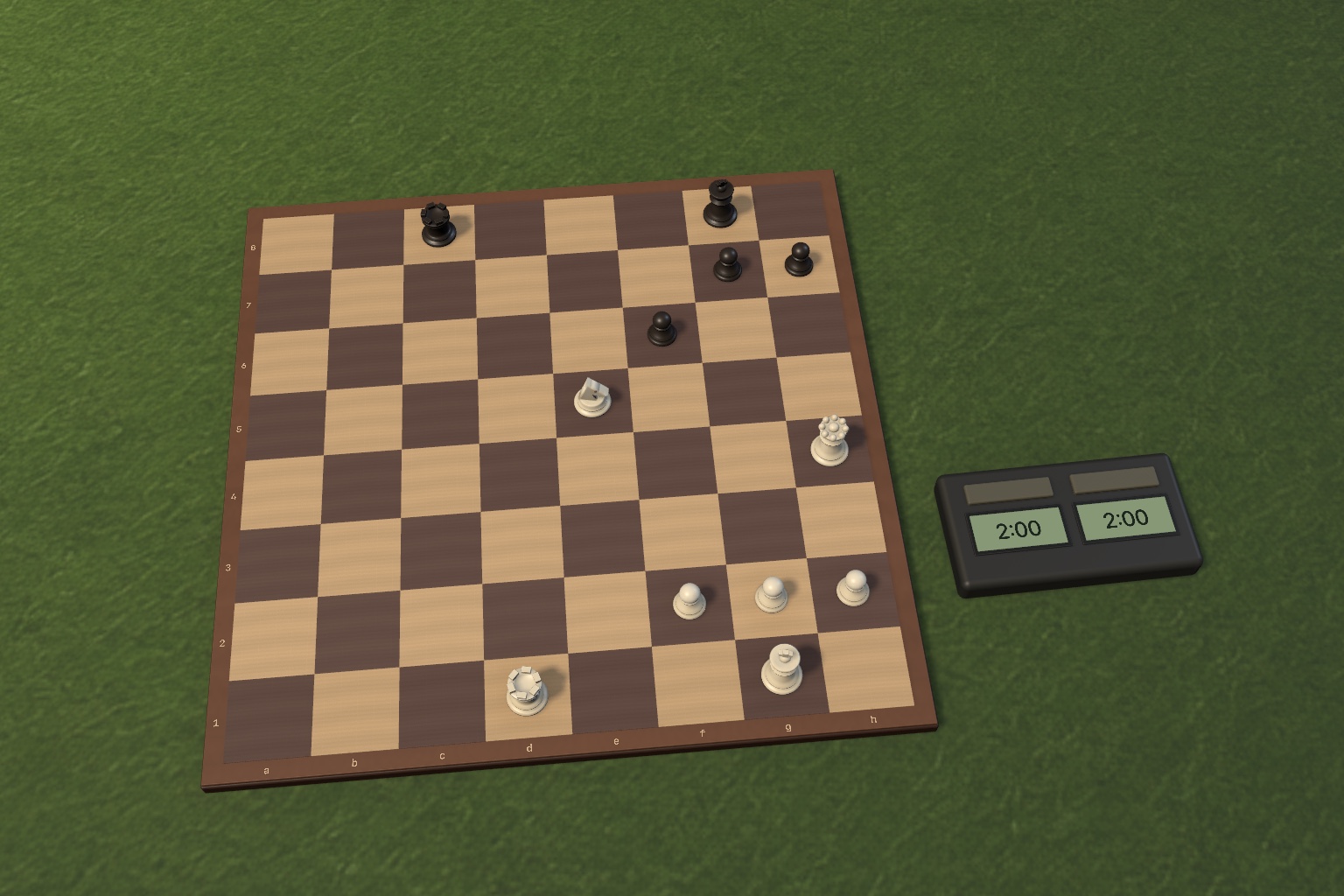
Python-chess enumerated every legal first move and every defense to the mate. The Lichess endgame tablebase checked both pawn-race results. The cover uses the 12 pieces from the mate exercise on a 3D board beside a rendered clock and a generated tabletop surface.