A 30-Minute Chess Training Plan for Busy Adults
A week of short sessions built around decisions from your games, with a 10-minute version for days that get away from you.
For a 30-minute chess session, spend 6 minutes reading the board, 12 minutes reviewing one decision, 8 minutes playing through replies, and 4 minutes writing a practice note. Give yourself separate days for playing, endgames, and testing a position you have never seen. If you only have 10 minutes, keep one board and one decision.
What to do in a 30-minute chess session
- 6 minutes
- Choose a position and look for checks, captures, loose pieces, and your opponent’s threat. Write one candidate before turning on the engine.
- 12 minutes
- Pick a decision from a completed game. Compare what you played with one other candidate. Work out the opponent’s reply you would least like to face.
- 8 minutes
- Play the two lines from the same starting board. Check where your calculation went wrong and what the better candidate preserves.
- 4 minutes
- Save the position, the reply that changed the result, and one question to ask yourself on a new board.
Set out a board or open an analysis tool before starting the clock. Have either one recent completed game or one preset position ready. If you spend most of the session choosing drills, start the next session with a specific board already saved.
The useful output is a decision you can explain and revisit. Your note might say “If I move the knight, their bishop can take my queen.” That gives you a question to test. “Study tactics this week” leaves you with a wide search the next time you sit down. See a completed-game review note
A seven-day chess training calendar
Move the days around your schedule. Each full session fits 30 minutes. If you already played earlier that day, use an existing completed game on the play day and spend the remaining time checking its key position.
- Monday · Review
- Use the 6/12/8/4 session above on one game you remember. Save a note about why the opponent’s reply worked.
- Tuesday · Tactics
- Spend 6 minutes recalling the cue, 12 solving unfamiliar positions, 8 replaying the one that surprised you, and 4 logging what you saw. Include at least one position where you have to defend.
- Wednesday · Play
- Allow up to 20 minutes for a game at 10+0, 6 for a quick review of one position, and 4 for a note. Finish the game before opening an engine. If the game uses the available time, review it on Friday.
- Thursday · Endgame
- Use 6 minutes to name a goal and inspect the position, 12 to play a finish, 8 to start a similar ending earlier, and 4 to note the reply or move that changed the result.
- Friday · Revisit
- Spend 6 minutes remembering the question without the answer, 12 on the decision from Wednesday’s game, 8 replaying it, and 4 comparing it with Monday’s note.
- Saturday · Test
- Use 6 minutes to choose unseen boards without reading the answers, 12 on first attempts, 8 to compare with checked replies, and 4 to record which attempts were independent.
- Sunday · Reset
- Take the day off or use the 10-minute session to organize the next game or position. Pick the question you’ll carry into Monday.
If you have three days, use one session each for review, play, and a fresh test. Add endgames on the next available session. If you already play regularly, use that middle slot to practise a finish or go deeper on the decision you marked. Download the weekly calendar and practice log
How a play day feeds a review day
On Wednesday, leave yourself a marker you can find on Friday even if you ran out of time to analyze. Note the move number, what you expected to happen, and whether the actual reply surprised you. Save the finished game or its PGN. A sentence is enough until you can put the position on a board.
Here is a worked handoff using the completed sample game from our puzzle guide. On move 24, White played Nc6+. The immediate idea was to give discovered check and attack a queen. Black blocked the check with …f6, and White took the queen. A useful first note is “I saw how to take the queen. Could I finish before Black could interpose?” On the review day, go back to the previous move and compare Nc6+, Nxg6+, and Black’s legal replies. In the checked line, Nxg6+ Kg8 Qh8# forces mate. Save the question about interposing for your next fresh board. Replay the game and try the move
If your usual time control includes an increment or can run past 30 minutes, schedule the game when you can finish it. Use the training slot for a completed game from your archive. Keep the review date and the game date in your log so you can connect what you studied with what you later played.
The 10-minute fallback
Use 2 minutes to open a saved board, 5 to compare one candidate with the opponent’s reply, and 3 to record the next question. You can finish this with the same note you use in a full session. Keep the answer closed until you have written down the reply you expect.
For example, open the first position below and ask what Black can do after the knight captures the pawn. Spend the five minutes working out exactly what the knight was guarding. After you check the line, record the cue and stop. On the next day with more time, add a different position where something is pinned and see whether you notice it before calculating the capture.
When you only have five minutes after a fast game, review one blitz move with its clock reading.
One worked review from the plan
White to move. The knight on f3 can capture the e5 pawn. Before you play Nxe5, look along the line from Black’s bishop on g4 to White’s queen on d1. Which white piece currently stands in the way?
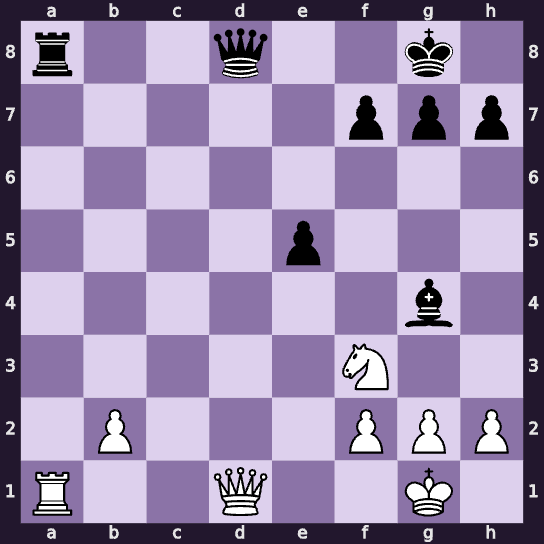
After 1.Nxe5 Bxd1 2.Rxd1, White has traded the queen for a bishop and a pawn. The queen was protected by the rook, but that recapture still loses material. One legal alternative is 1.Qxd8+ Rxd8, when both queens leave the board and White keeps the knight on f3. The exercise is about checking what the capture exposes, with room for other sound choices.
Copy the worked positionr2q2k1/5ppp/8/4p3/6b1/5N2/1P3PPP/R2Q2K1 w - - 0 1
Write the note as if this were your Monday review. My candidate was Nxe5. The reply I missed was Bxd1. My question for the next board is “After the piece moves, what does it stop shielding?” The example and lines were checked with python-chess and Stockfish 19.
In a Stockfish 19 run at depth 16, with each candidate checked separately, White’s evaluation was about +0.99 for the queen trade and −9.48 for the knight capture. Those readings depend on the search settings. The queen-for-bishop-and-pawn trade on the board is the concrete reason to keep this position in your notes.
Test the idea on a fresh position
Return here on a later session if you want this board to be your fresh test. White to move. Before opening the answer, decide whether Bxh5 is legal. If it isn’t, name one legal king move that changes the situation. Write down why before checking the result.
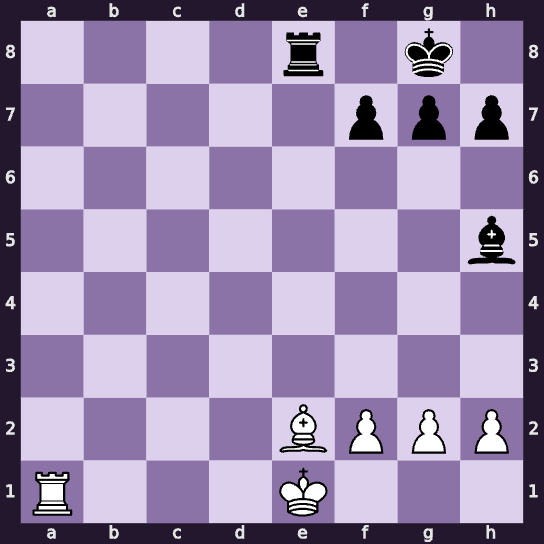
Copy the fresh position4r1k1/5ppp/8/7b/8/8/4BPPP/R3K3 w - - 0 1
Check the fresh position
Bxh5 is illegal. Moving White’s bishop from e2 would let Black’s rook on e8 give check along the e-file to White’s king on e1. Kf1 is one legal way to move the king off that file. The first example involved a queen and a legal move with a bad result. Here the king makes the bishop move illegal.
Record a first attempt as correct if you identified the legality and could explain the e-file before opening the answer. Note whether you also found a legal king move. The examples share a theme, so add some unrelated positions on Saturday if you want to test whether you detect a pin without any cue. Retrying either board after seeing the answer is useful recall practice.
Track what happened across two weeks
Keep the log small enough to fill in after each session. Write the date, the source position, your first answer, whether you used a hint, and the checked reply. On Saturday, count first attempts on unfamiliar boards separately from retries of saved positions. You can then compare similar tasks without mixing up recall and a fresh decision.
For example, suppose you got 2 of 3 fresh boards right without a hint, and replayed a fourth after reading its answer. Record the fourth as a retry. Look at the one fresh board you missed. If you saw the threat but chose an illegal answer, focus the next session on legal replies. If you never looked along the file, practise the initial board scan. A few positions can guide what you try next. Changes in game performance need evidence from later games.
For actual games, compare completed games of a similar time control and review the same stage or type of decision. Give yourself a numerator and a denominator, like “I checked the opponent’s first reply on two of four reviewed captures.” That is easier to act on than a rating change after a single week.
Decide what changes in week two
Read your notes together before changing the calendar. If several decisions have the same reply in common, give that idea the next two review slots. If your misses have different causes, keep the same routine for another week and collect a few more examples before choosing a theme. Here are ways to make a specific change without reworking the whole plan.
- You notice threats too late
- On the first two review days, say what changed on your opponent’s last move before choosing your own. Test the cue on later completed games. Use the three-question blunder check.
- You see a threat but misread its reply
- Take one old position and two unfamiliar ones. Write one legal reply before you move. Check whether you missed a block, capture, or king move.
- You reach a won ending and draw
- Keep a short mate drill for Thursday, then start a similar position earlier and play to the actual result. Log the first move where the defender escaped or the game became a draw.
Keep the review based on what you actually checked. If you have only reviewed three tactical positions, you still need examples before drawing a conclusion about your openings or endings. If your rating dips during the week, finish the review and ask what the games show about the decision you practised.
Where to get the positions
To play either diagram in Tera Chess, open Analysis board → Position & PGN, paste its FEN, and select Load FEN. You can try a legal candidate on the board before choosing Analyze position.
Start with your own completed games when you have a decision worth revisiting. Use a mix of unrelated puzzles or a preset ending to get an unfamiliar board. Lichess Practice offers exercises by technique, and Chess.com publishes study plans by level. Pick one exercise that matches the day’s job. Lichess Practice exercises · Chess.com study plans
For this week, use the free Tera Chess boards for the tactical warm-up and endgame day. You can also import completed Chess.com games by public username in the signed-in workspace and practise from the positions it analyzes. Public checkmate puzzles · Play a rook, queen, or pawn ending
Common questions about a short chess routine
Should I study openings in a 30-minute session?
Use an opening slot when your review shows a recurring problem early in the game. Rewind to the first decision you had to make on your own and compare two sensible moves. Save the idea that carries into the middlegame, such as which piece needed to develop or which pawn break you were preparing.
Is 30 minutes a day enough to work on my chess?
It is enough time to review one decision, practise a short ending, or make several fresh attempts and check your reasons. Give longer games their own slot when you can. Use the shorter sessions to work on the decisions those games give you.
What if I miss two days?
Pick up with the next task you have a board for. Use one short review to reconnect with your saved question. If your week only has three open slots, keep review, play, and one fresh test.