How to Review Blitz Games in Five Minutes
Pick one decision, check what the clock says, and leave with a question to ask in your next game.
To review a blitz game in five minutes, pick one decision from a finished game, note the clock before it, and work out the opponent’s best reply to two moves. Save one question to ask yourself next time. The five minutes can tell you where to look in the next game, even if you leave most of this one untouched.
Below, a completed 3+1 game gives us two useful candidates for review. White spent 34.2 seconds on move 14 and 1.4 seconds on move 31. Play the later decision and see why the longer think and the costlier move deserve different questions.
If you need a moment before replaying the game, use the one-game debrief after a bad loss. Save the move now and come back for the review when you are ready.
Set a five-minute timer after the game
- 0:00–0:45
- Find one decision. Start with a reply that surprised you, a move you played very quickly, or a decision that took a large share of your remaining time.
- 0:45–1:30
- Rewind to the board before your move. Write what your opponent had just done and how much time you had when it became your turn.
- 1:30–2:30
- Leave the engine off. Write what you hoped your move would do, the reply you expected, and one alternative to compare.
- 2:30–4:15
- Check the opponent’s best reply to each candidate. Replay until you can point to a threat, a piece that can be taken, or a position that changes your plan.
- 4:15–5:00
- Save the game link or position, the checked reply, and one short question you can use in another game.
The timer is for the review. Put it aside while you’re playing. Start the review after the result is recorded. If the first position you pick takes the whole session to understand, save it and move on with a clear question to revisit. A quick review works best when it ends with something specific you can try again.
When you remember several mistakes, choose the earliest one you can explain from the moves. If a wild scramble came after a clear missed threat, start with the threat. If the position was already difficult but your clock gave you little room to check, look for the earlier move where the time went. A win can contain a good review moment too. Pick the place where you would want a second chance to decide.
Decide which kind of mistake to review
For a missed tactic, stop before your move and point to the piece that could capture, check, or uncover an attack. If the game ended on time, move back through your last few turns and find the first position where the clock started dictating your choices. Then look one decision earlier. You’re looking for a point where you had a usable move and enough time to consider it. If the board was already lost, choose a different game for the clock question.
When the final mistake is obvious, spend your review on the earlier move that made it possible. For example, if you lost a rook to a fork, rewind until you can decide whether to keep the rook on the file or move it to safety. Find the move you could have played before your opponent had the fork. That earlier choice gives you a position to practise.
Read the clock before you diagnose the move
Separate two questions. How much time was available when your turn began? Then ask how much of that time did the move use? An export can contain a time remaining after your move. In an increment game, it may already include the seconds added for completing that move. Compare two readings for the same side. Never subtract your opponent’s clock from yours.
For these post-move readings, estimate the time charged as your previous clock + increment − your new clock. The sample is 3+1, so one second comes back after each completed move. When your source supplies elapsed time per move directly, use that reading. Rounded displays, clock adjustments, and lag can make it hard to infer an exact thinking time from a replay. Write down what the source actually shows. Chess.com’s increment explanation · How to show Chess.com move times
Two clock readings from the same 3+1 game
- 14.Ng5, White
- 1:34.5 before, 1:01.3 after. 94.5 + 1 − 61.3 = 34.2 seconds charged.
- 31.Rxh7, White
- 13.0 before, 12.6 after. 13.0 + 1 − 12.6 = 1.4 seconds charged.
Both rows come from the clock comments in the completed February 4, 2025 game between grnic1 and Hikaru. For the first row, White’s previous recorded clock is the one after 13.Nf3. For the second, it is the clock after 30.Rf7. The intervening Black move changes the board while White’s clock is paused. Source game and move list · Chess.com archive format
I’d begin with move 31. There are two concrete threats to find when the knight moves. Move 14 is a separate question about what White had to calculate and when it was worth spending the time. The clock record gives us the contrast. We can review the decision without guessing either player’s thoughts.
Move 14 also makes a good check on hindsight. A long think can be appropriate when the position changes sharply. If this were your game, replay Black’s preceding castling move, note what it changed, and test whether your extra time led to a better decision. For move 31, try the same clock exercise using just the two candidate moves and the first reply to each. That keeps the later review close to what you could actually calculate in blitz.
Play the decision after 30…Rxe6
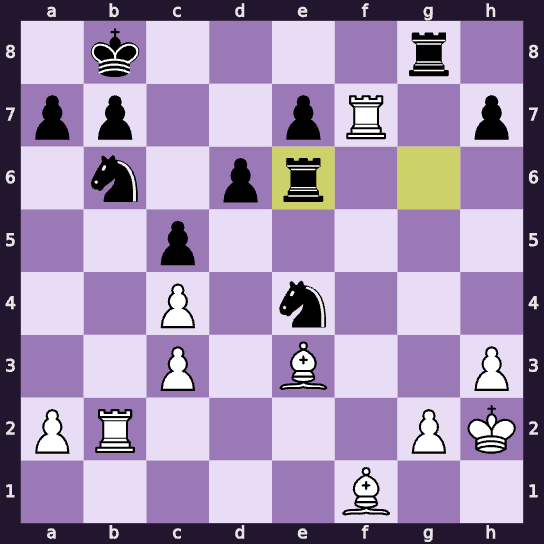
Take a minute before playing. Black’s rook is on e6, Black’s knight is on e4, and White’s rook on f7 can capture the h7-pawn. What happens to the e-file if the knight moves? Pick a move for White and name the reply you most want to avoid.
The playable board couldn’t load. Use the diagram and checked lines below.
What happens if you take on h7?
Select a piece and destination or drag to move. With a keyboard, use the arrows and Enter.
Check the game move and two alternatives
White played 31.Rxh7. Black replied 31…Nf6. The knight now attacks the rook on h7 and has moved out of the way of Black’s rook on e6. Follow the e-file down to the white bishop on e3. In a checked continuation, 32.Rh6 Rxe3 saves the white rook and loses the bishop. The actual game stopped after Nf6, when White resigned.
31.Bd3 is one stronger candidate. It attacks the knight on e4 with the bishop from f1 and keeps the rook on f7. In the checked line 31…h5 32.Bc1 Na4, White moves the other bishop off the e-file. Check 31.g4 too if you found it. One line is 31…Rf6 32.Rxf6 exf6 33.Bf2. White can trade a rook without putting it on h7.
Stockfish 19 at depth 19, with three lines, gave about −0.22 for Bd3 from White’s perspective. In a separate search after the actual reply 31…Nf6, it gave about −6.43. These numbers locate the decision. The exposed bishop and the attack on the rook explain it. The playable board follows prepared lines. How to read an engine score
Copy the position before move 311k4r1/pp2pR1p/1n1pr3/2p5/2P1n3/2P1B2P/PR4PK/5B2 w - - 0 31
Imagine reviewing this position without the clock data. You can still find the double threat. Add the clock and you can also ask whether a faster scan of the e-file was available. Save that as a question for practice. When you see the board again, choose the move before opening the line, and remember that you’ve already seen this example.
Spend the last engine minute on the first reply
When the engine shows a long line, play only as far as you need to explain its point. In this example the first reply already tells you where to look. Move the black knight to f6, trace its attack on h7, then trace the newly open e-file. If you use all your time stepping through later moves, you may miss the simple test you can apply to a different position.
Turn the review into one note you can use
Keep the note small enough to finish before the timer rings. In the sample, it could read “31.Rxh7 with 13 seconds left. I wanted the pawn. After …Nf6 the rook on h7 was attacked and the e6-rook could take the bishop on e3. Before grabbing a pawn, trace the file an opponent’s knight could uncover.” The first-person sentence shows how to write your own note. It is an illustration of the process.
If you missed the candidate entirely, practise spotting what the opponent’s last move changed. If you saw both moves but stopped the line too early, practise giving the opponent one reply before making up your mind. If you found the move afterward and the earlier clock was unusually tight, look through the prior moves for one longer think you can reconstruct. A single blitz game is enough to choose one drill. Look for the same pattern in later games before deciding it is a recurring problem.
Try the question first on a fresh position in a mixed set. When you play through your old position, record it as a retry. In a new game, check after the result whether you saw the cue under your actual time control. Try a mixed test with quiet positions
For a second review later in the week, take the same question into one other completed game. Write whether you noticed the open file before your move, saw it only after the reply, or never encountered that situation. Those are different observations. If the new game never presented the cue, keep the question for another game. A saved line can help you recognize the pattern when it comes up again.
Keep the total time bounded. One tactic you can explain is a useful result from five minutes. Leave a deeper opening question or an ending you cannot evaluate for a longer session, with the board and two candidates saved. Fit longer reviews into a weekly plan
Where to find the moves and the clock
Chess.com can show per-move times in the game record. For a file, use the PGN export with timestamps selected when available. Lichess documents clock inclusion in its game export. Open the original game for the time data when a pasted copy has lost its annotations. Tera Chess can load a completed standard game or the FEN above in its Analysis board. Use it to replay the decision and check the alternative. Keep the source replay or original PGN alongside your note when clocks matter. Download a Chess.com PGN · Lichess game export options · Compare the analysis boards
Common questions about fast game reviews
What if my game has no clock data?
Use the same timer. Pick the reply that surprised you, replay the move, and check an alternative. Leave the clock field blank if the source has no reading. A memory such as “I felt rushed” can go in your personal note if you label it as a recollection.
Should I pick the biggest drop on the evaluation graph?
Start with a point you can turn into a decision. In a severe time scramble, the biggest drop can come later than the move that made the defense difficult. Compare two candidates before the earlier decision and see whether you can name the problem each reply poses.
How many blitz games should I review at once?
Pick one if you only have five minutes. If two games had the same recurring threat, save the second position for a fresh comparison on another day. Checking one candidate and its reply gives you a usable note.