What to Do After a Bad Chess Loss
Pause before the next game, review one decision, and bring one useful question back to the board.
After a bad chess loss, pause before you start another game. Save the game and write down the position you remember. When you are ready to look at it again, replay one decision, find the reply that made it matter, and take one question into your next game.
You can do the pause now and the review later. The completed blitz game below shows what a short debrief can uncover. White spent 1.6 seconds on a king move, then lost a bishop through a sequence of checks. Replaying the decision gives you a specific way to practise it.
What to do immediately after losing a chess game
If you are already reaching for Rematch because you want the rating points back, leave the queue closed for a moment. Take your hands off the mouse, get up, or look away from the board. Then ask whether you are willing to pay attention to a fresh position even if the next game also goes badly. If the answer is no, end the session or come back later.
Before you leave, save the game or write down the move number you want to revisit. If you can still recall a thought you had, capture it in one sentence. “I saw the rook capture and planned to take back with the king” is useful. “I must have panicked” is a guess unless you remember that happening. Put a question mark beside anything you are reconstructing afterward.
Between scheduled tournament rounds, keep this step short. Write the move number when the game is over, and do whatever you normally do before a round. If you have only enough time to get to the next board, leave the variations for after the event. You can remember the decision from a game record even if you are unable to reconstruct every thought right away.
Players use tilt for the feeling of carrying frustration into the next game. The result on its own gives you little evidence about what will happen next. A 2026 study of almost a quarter billion online games found that results were correlated across games, while its natural experiment found no evidence that a small advantage affecting the prior result caused better performance in the following game. Use the pause to check whether you have attention for another position. Adrian Poignant’s study in The Economic Journal
A one-game debrief when you are ready to review
- Write the result and how it ended. Mark resignation, checkmate, or time separately from what the board showed. If you flagged, open the last position where you still had time and a meaningful choice.
- Pick a decision you can replay. Start where you hesitated, where the opponent surprised you, or where your position changed sharply. Go back to before your move. Look first for a moment with a better choice you can explain.
- Play both versions. Play the original move and give the opponent their strongest verified reply. Try one reasonable alternative from the same board. Follow both until you can say what happened to a piece, a critical square, or the clock.
- Stop with one question. Write a prompt you can remember before your next game. Keep it short enough to use during play on your own. Save the position for a later retry.
When a loss has several mistakes, choose one you are likely to recognize again. If your pieces were already tied down for ten moves before the last tactic, you might learn more from the earlier trade that left them without squares. If the board was still playable until a rook was lost, start with the position before the move that allowed it. Find the earlier decision behind an evaluation swing
Choose a move that fits the way the game went wrong
If you lost a piece, back up far enough to find the last moment you could keep it safe. Play the strongest reply to the original move. If you were squeezed for several moves, choose an earlier decision where you could have contested an open file, kept a defender, or traded a dangerous piece. In each case, save the decision you can actually make again.
If you flagged with a playable position, keep the board and the clock in the same note. The time spent on your last move can be less useful than the earlier decision where you spent most of your remaining time. With no increment, subtract consecutive clock stamps for your side. If the clock added time after each move, account for the increment before using the elapsed time. Mark the clock as unknown when the game score has no timestamps.
Download the one-game debrief card
Play the king decision from a real blitz loss
In a completed three-minute game on July 9, 2025, Benjamin Bok had White against vugarrasulov on Chess.com. After 42…Rc3, White’s king stood on e1 and Black’s rook attacked the bishop on f3. White had a rook on a8 and a knight on d6. Before reading the continuation, try a king move and ask what happens if Black takes on f3. Completed game and clock record
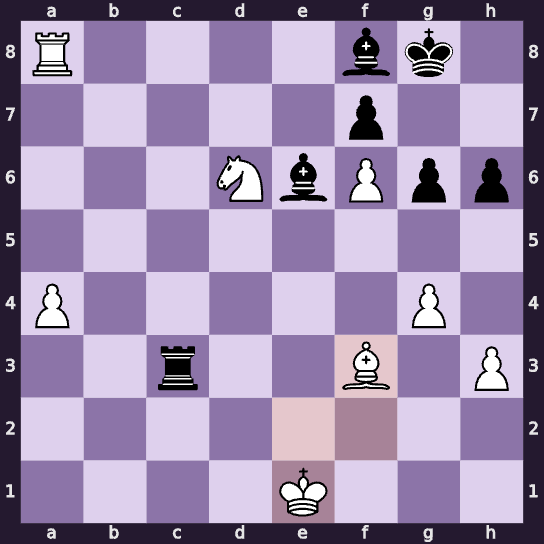
The board couldn’t load. The diagrams and checked lines below show the same decision.
Which king move keeps White out of the skewer?
Select a piece and destination or drag to move. With a keyboard, use the arrows and Enter.
Copy the position to another analysis boardR4bk1/5p2/3NbPpp/8/P5P1/2r2B1P/8/4K3 w - - 14 43
What Black gained after the king moved to f2
The played line was 43.Kf2 Rxf3+ 44.Kxf3 Bd5+ 45.Ke3 Bxa8. First Black took the bishop on f3 with check. White could take the rook with the king. That put the king on f3, where Black’s bishop could check from d5. The same bishop looked the other way down the diagonal toward the rook on a8. White answered the check and Black took the rook. Compare a pin and a skewer on two matched boards.
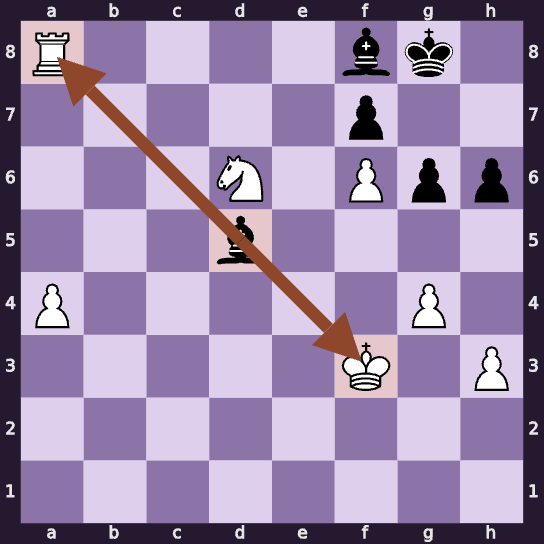
Both rooks came off, and White had also lost the bishop on f3. Black found the second check that made the sequence work. Try pointing to the two halves of the diagonal before you try the line again. White’s king sits on d5–e4–f3. The rook sits on d5–c6–b7–a8.
The game continued for several moves, with White pushing the a-pawn. White resigned after 52…Bxb5. A debrief that opens only to the final bishop capture misses the chance to compare the king moves before the earlier combination.
Why 43.Ke2 changes the calculation
With 43.Ke2, Black can still play rook checks. In one checked line, 43…Rc2+ 44.Ke1 Rc1+ 45.Kd2, the king gets away and the bishop remains on f3. Keep playing the branch to see Black’s rook return to c7.
It helps to try Black’s original idea too. After 43.Ke2 Rxf3, the rook capture comes without check. White has time for 44.Rxf8+ Kxf8 45.Kxf3 in one checked continuation. White uses the rook on a8 before recapturing. On f2 the king has to answer the original rook check immediately. On e2 White gets a choice about move order.
Keep going one move in that second example. Black can still play 45…Bd5+. This time the white rook has already captured on f8 and been taken. There is no rook on a8 for the bishop to win. That is the detail to write alongside the two lines. The question is what the check gains in each position.
You can test the same idea as Black. After Kf2, name what you are giving up with Rxf3+ before you decide to play it. If White captures the rook, the move succeeds because you have a second check that recovers the other rook. That is a more precise description than “Black got a bishop for free,” and it helps the pattern make sense when you meet it from either side.
In independent depth-19 searches, Stockfish 19 assessed 43.Ke2 at +1.39 and 43.Kf2 at −5.46, from White’s point of view. The searches each allowed one first move, used one thread, and cleared the 64 MB hash between candidates. The difference shows up on the board as a forcing sequence that wins material. Read Stockfish’s position estimates
What to put in the debrief for this game
- Result
- White lost by resignation after 52…Bxb5.
- Position to save
- White to move on move 43, after Black’s rook moved to c3.
- Clock facts
- White’s last two stamps were 38.0 and 36.4 seconds. With no increment, the elapsed time on Kf2 was 1.6 seconds.
- Reply to remember
- Rxf3+ drew the king to f3 when White recaptured. Bd5+ then attacked the king and rook.
- Alternative
- 43.Ke2, with a different route through the rook checks.
- Next-game question
- If my king recaptures, what check can follow?
Save the position under a neutral name like “White, move 43.” Keep the answer on the card. When you come back, the board will show you the pieces while the name leaves you the work of finding the critical reply. If you keep a journal, use one entry for this decision with a link to the full game.
The clock shows how long the move took. To diagnose why you moved quickly in one of your own games, compare that clock stamp with what you remember. You may have seen Rxf3+ and stopped the line at Kxf3, or you may have missed the rook capture entirely. Those call for different practice. The first is a calculation habit. The second is about noticing what the opposing rook already attacks.
Give the opponent credit in the note when they found something strong. “Black saw that Bd5 comes with check” identifies a real decision worth learning from. It is also useful if you play the other side in practice. You can see why Black should look at the bishop before assuming the rook capture is a bad trade.
Set a cue before you play again
Before your next game, say your one question from memory. In this case, “If my king takes back, what is their next check?” is specific enough to apply when a capture pulls the king onto a new line. If you are still thinking about making up the loss, leave the next game for later. If you do play, judge your return by whether you gave the new position attention.
Replay the saved position on another day. Name the checks after both king moves before showing a line. Recognizing the position and remembering Ke2 counts as recall. For a fresh test, find another completed position where a king can recapture and ask the same question before you see the answer. Sometimes the king recapture is safe. Your job is to verify the reply in front of you. Try fresh positions without a tactic label
Make the retry short enough to finish. On this board you can start with two candidates, play a Black check after each one, then stop after you can explain the difference. If you already remember that Ke2 works, try explaining why Rxf3 is no longer a check before you look at the move list. When you play a fresh game, keep the cue in your head and let the new board decide whether it applies.
What if you have lost several games in a row?
Start with one completed game and save a second for later. If both notes point to the same missed reply, you have a clearer practice target. If one game ended on time and the other contained a tactical mistake, keep those explanations separate. A losing streak and a repeated mistake are different observations. The decision you can show on the board is the better place to start.
When you have notes from several games, use the same tags in a chess mistake journal so you can find and practise the decisions that recur.
Pick a tool for reviewing the lost position
- Chess.com
- Use the timestamps to check how much time you used, then open Self Analysis to play a different reply. Chess.com’s timestamp guide
- Lichess
- Import the game or open the finished game’s Analysis board. Use a Study to save the original move and your alternate line together. Lichess’s guide to analysis and studies
- Tera Chess
- Open the Analysis board to replay the completed game or load the saved FEN. Compare one branch, then practise positions from your own imported games. Open the Analysis board
Questions after a painful chess loss
Should I review the whole game right away?
A short note can be enough before you step away. Review one position when you are willing to play the opponent’s reply carefully. If you later want a full review, use the same saved game and keep the original note. Try an engine-free first pass
How long should I wait before playing again?
Use a readiness check. If you can focus on a fresh position and accept either result, you can choose to play. If you open the next game mainly to recover the points, try a longer break. A fixed number of minutes cannot tell you how ready you are.
Should I stop playing blitz after a bad loss?
Decide what you want from the session. If you want time to test a check or a recapture, try a slower game on your next session. If the issue was one identifiable tactic, you can review it without making a change to every game you play. Use a five-minute blitz review for a quick follow-up