How to Build a Chess Mistake Journal
Keep one entry per decision, use the same tags across games, and turn a repeated problem into a practice session.
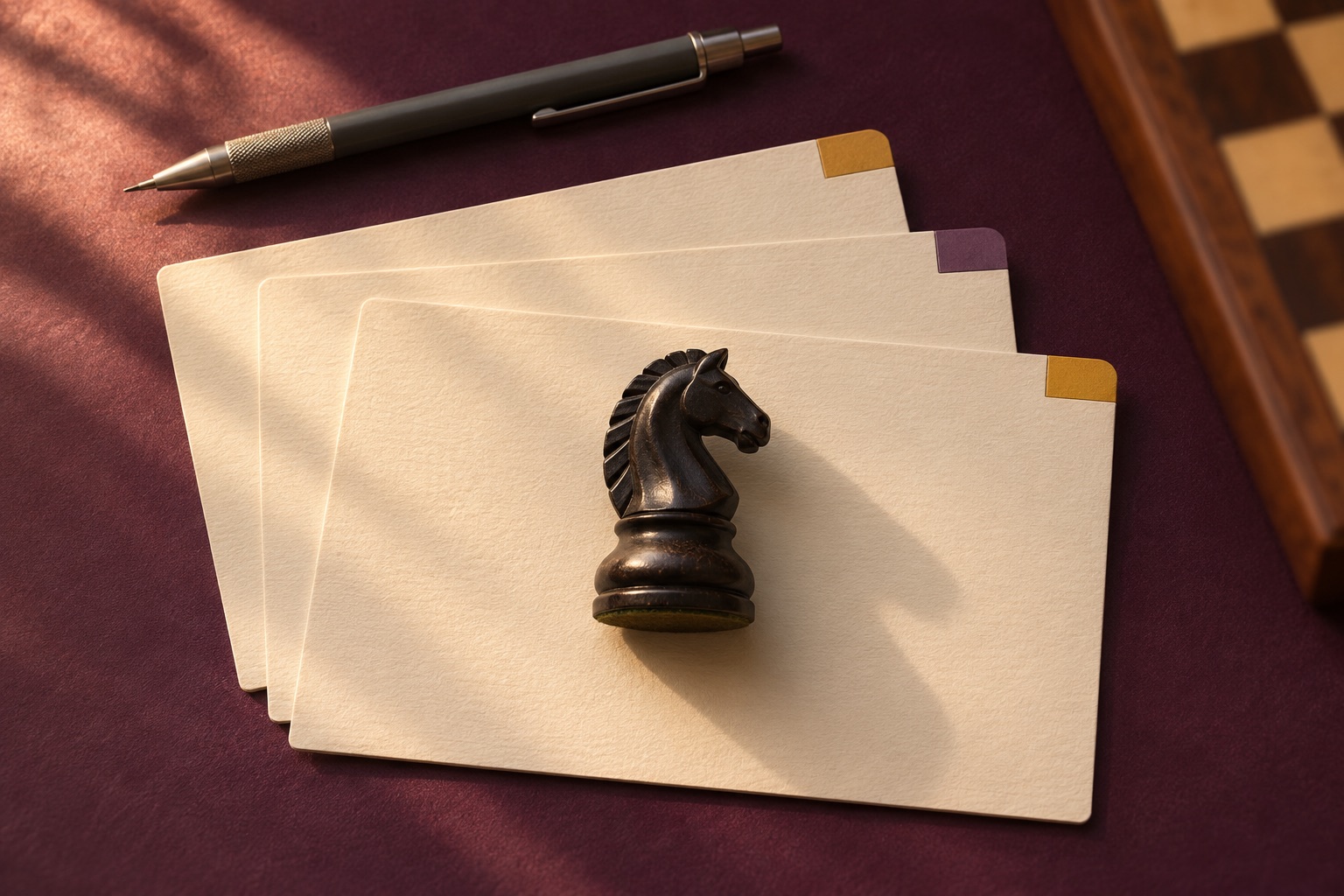
To build a chess mistake journal, save one decision from a completed game. Record the position before your move, the reply that mattered, one checked alternative, and a question to practise. Use the same small set of tags across games, so you can find similar decisions again.
Start with the copyable template below. Then play through three completed blitz games. In two entries the board points to the same practice task, checking an opponent’s forcing reply. In the third, the player lost on time from a playable position, so the journal points back to the clock instead.
What to record in a chess mistake journal
A game score can tell you everything that was played. A journal entry should help you reconstruct the one choice you want to study. Save a link to the completed game or a PGN and record the move number and side to move. Add a FEN if the entry needs to work without opening the whole game. For a loss on time, distinguish the last move you played from the last position in the game.
- Game
- Date, color, time control, result and how it ended.
- Position
- Move number, side to move, link or FEN, and clock stamps if available.
- Before checking
- Your remembered thought, candidate, or expected reply. Mark it unknown if you cannot remember.
- Checked line
- The move played, one important reply, and one alternative from the same position.
- What changed
- One sentence about a square, piece, clock decision, or resulting position.
- Tag and question
- One primary tag, an optional motif, and a question for a later try.
- Follow-up
- Date, whether you had seen the answer, and what you found before using a hint.
Download the journal template and three examples
Write your first thought down before turning on the engine. After checking, add a second note with what you found. If you rewrite your first thought to match the checked line, you lose the chance to see where your calculation changed. A short record can do this as well as a full annotated game when you know which decision you want to examine. See a worked first pass with the engine off · Anthony Levin’s guide to annotating games
Five primary tags that lead to a practice task
Pick the tag that tells you what to do with the position next. Keep the motif in a second field. For example, a skewer and an opened file can both belong to Forcing reply. Both may ask you to play a capture for your opponent and keep going one move past the obvious recapture.
- Forcing reply
- Replay a specific check, capture or direct threat. Record the move and the first consequence you can explain. Use a motif such as skewer, fork, or opened file if it helps you find similar positions.
- Plan
- Compare what changes after a trade, pawn move, or piece improvement. Record the new target or square along with the two resulting positions.
- Endgame technique
- Practise a specific method for converting or holding an ending. Save the starting position and an idea you can explain, such as keeping the king in front of a passed pawn.
- Opening recall
- Rebuild an opening position you meant to know and explain the purpose of the move. If a later capture caused the problem, check that reply before spending the session memorizing a line.
- Clock
- Inspect verified time use, low remaining time, or a flag. Save an earlier timestamp when you still had time to make a choice.
Sometimes more than one label fits. A skewer in a rook ending still gets Forcing reply when the next practice task is calculating that check. A fast move also gets Forcing reply if the board shows a missed capture and you have no evidence that time use was the issue. Add the time stamp under context. Use Unclassified when the relevant evidence is missing. You can fill it in after another look.
Keep the tag names stable for a few reviews. If you decide to rename a tag, update the equivalent earlier entries so a search still finds them. Reserve new tags for a genuinely different practice task. You can always describe an unusual tactic in the motif field.
How to tag a position when the cause is uncertain
Start with what you can verify. In a note about a lost piece, record the capture and the reply that made it possible. Then look at the thinking note. If you remember seeing the capture but assumed the recapture ended the line, your practice question can be “What is the move after I take back?” If you do not remember seeing the capture at all, you can practise finding the opponent’s first forcing move. Both entries can stay under Forcing reply while the questions describe different work.
Do the same thing with the clock. A timestamp can show that you used one second or fifty. For a time-use entry, ask whether an earlier decision left you with very little time and whether that earlier position offered a straightforward option. You can keep a clock observation even when you have yet to identify a better way to spend the time.
Three worked entries from completed Benjamin Bok games
All three games were played at three minutes with no increment in July 2025. The move lists and clocks are from the public Chess.com archive. The tags are the journal’s labels for review tasks, and the player’s original thoughts are unknown. The games were selected to demonstrate how the tags work. Public game archive
On the first two boards, play the game move and step through the reply. On the third, the game had already ended on the clock. Any move you make from that board is a checked variation for practice.
The board couldn’t load. The diagrams and checked move lists below show the journal entries.
Which rook remains to protect the b-file after the recapture?
Select a piece and destination or drag to move. With a keyboard, use the arrows and Enter.
Game 1 · Forcing reply, with an opened b-file
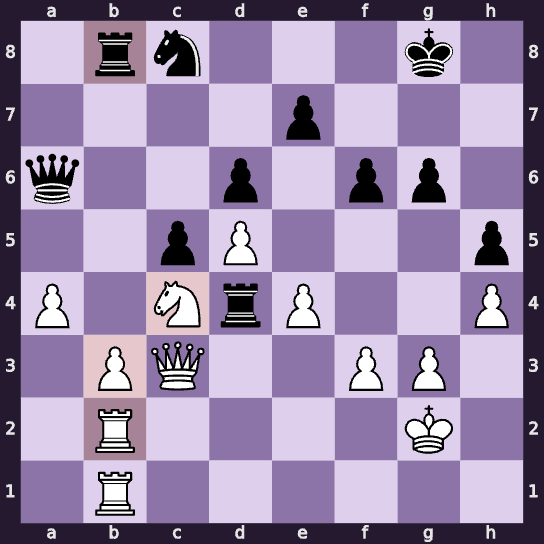
Against yosephtaher on July 2, Bok played 40.Rd2 Rxc4 41.bxc4 Rxb1 and resigned. The rook on b2 had moved to d2. Then the b3-pawn captured on c4 and cleared the file. Black’s rook on b8 now had a path to b1. White had lost a knight as well as a rook, while Black had given up a rook. The journal entry can stop at the open file because it explains the difference. Original game and result
Compare 40.a5. In the illustrative line 40…Rxc4 41.bxc4 Rxb2+ 42.Rxb2, White’s rook on b1 can take back because the other white rook was still on b2 when the file opened. Black can choose another reply to a5. Trying the same capture sequence makes it easy to see why keeping the rook on b2 changes this one line. Save the question, “After my pawn recaptures, what line did it open?”
Game 2 · Forcing reply, with a bishop skewer
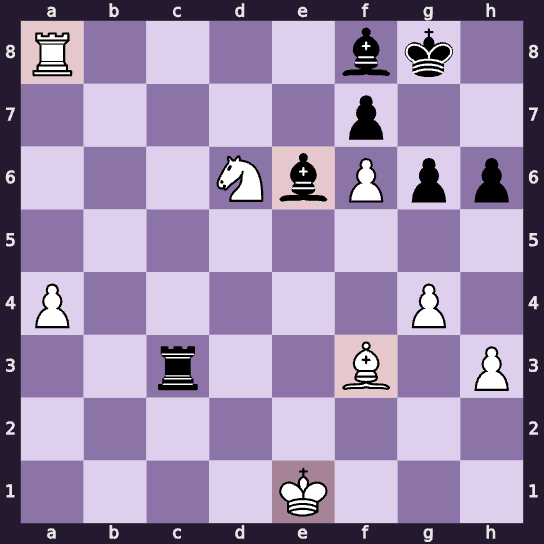
Against vugarrasulov on July 9, the game went 43.Kf2 Rxf3+ 44.Kxf3 Bd5+ 45.Ke3 Bxa8. The check on f3 let the bishop take the rook on a8. A checked alternative was 43.Ke2 Rc2+ 44.Ke1 Rc1+ 45.Kd2, where the rook checks leave the bishop on f3. The study tag stays Forcing reply, even though the motif is a skewer. Save the question, “After my king recaptures, what is the next check?” Original game and result · Read the complete debrief for this position
Game 3 · Clock, with a playable final position
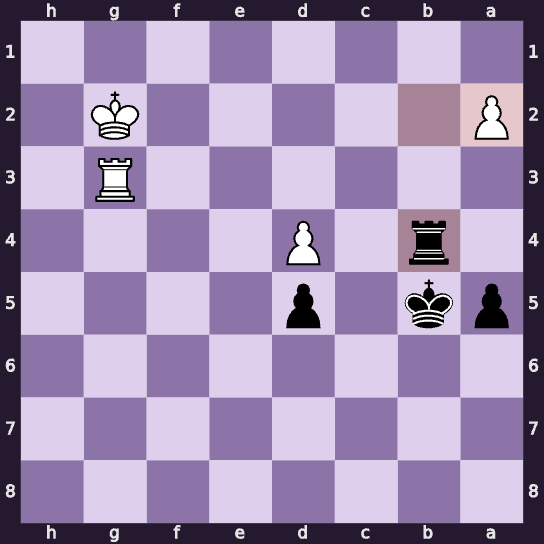
Against MaxiDag30 on July 2, Bok had Black. His last move was 87…Rb4 with 0.1 seconds left. White answered 88.Kg2 and won on time. There was no 88th move for Black in the game. In the checked continuation 88…Rb2+ 89.Kf3 Rxa2, Black’s rook has an active check and can take the pawn on a2. That line belongs under practice, with the played game still marked as a time loss. Original game and clock record
In this entry, start the clock review earlier. The first recorded Black stamp below ten seconds came at 64…Kg7, from 10.5 seconds to 9.4. That gives you a specific place to look back. The stamp can help you locate the time decision without guessing how the player felt. Save the question, “When did my available thinking time shrink, and what was the board asking of me there?”
See the independent engine checks
- Before 40.Rd2
- −3.88 for Rd2 and +2.16 for a5 from White’s side. One checked response to a5 is 40…Kg7.
- Before 43.Kf2
- −5.46 for Kf2 and +1.39 for Ke2 from White’s side.
- Final board after 88.Kg2
- +3.93 for Rb2+ and +4.15 for Kc4 from Black’s side. Both are unplayed continuations.
Stockfish 19, depth 19, one thread, 64 MB cleared hash, one allowed first move per search. Numbers estimate positions from the indicated side. The illustrative repeated-capture branch after 40.a5 is included to compare the open file in the two positions.
Turn repeated tags into a practice session
The worked set contains two Forcing reply entries and one Clock entry. That count describes these three selected games. For your own journal, count the number of games you reviewed, and keep the game links with the entries you count. Include decisions from wins and draws when the checked reply matters. A serious unpunished mistake still gives you something to practise. Replay a missed reply from a game you won
- Open the entries with the same primary tag. Start before your move in both positions. Keep the answers out of view.
- Use a common question. For these two Forcing reply entries, ask what check or line opens after the expected recapture. Play the reply on each board.
- Try one fresh position. Choose a completed position you have yet to review where a capture is available. Sometimes the straightforward recapture is sound. Explain your choice either way.
- Record what the attempt showed. Mark an old answer you remembered as recall. Record a hint or a second attempt separately. Keep your first attempt on a fresh board available to compare later.
A clock practice session needs a different setup. Review earlier clock stamps at a comparable time control and ask where you still had enough time to make a decision. If the same time pattern comes up on several games, test one adjustment, such as reserving enough time to scan the reply in an ending. Keep the clock record separate from the notes on the played moves.
When you review a fresh game, add an entry if you can name a meaningful decision. Leave a note that you reviewed the game even when you find no suitable example for the tag. This gives you a more useful record than counting only dramatic mistakes. Try fresh positions without knowing the tactic
When you update the journal, append the new attempt to the original entry. One game can supply a position you replay three times. That is one recorded decision with three attempts. If two different games bring up the same question, keep both game links and both starting positions. Later you can compare what you saw in a familiar position with what you found on the first try in a different one.
If you want a compact weekly summary, write “Forcing reply, two entries across three reviewed games” and add the question you will test. Leave the result open until you do the test. The count is a way to select the next session, and you can update it after another week of reviews.
Where to keep a chess mistake journal
- Notes or spreadsheet
- Use one row or short entry per decision, and keep the tag in a dedicated field. A game link and move number let you keep the note short.
- Chess.com
- Save an annotated game with comments and alternate lines in your Library. Use the same tag text in each comment if that is where you keep notes. How to save comments and variations
- Lichess
- Keep a game and its variations together in a Study chapter. Save the FEN in your journal if you want to open the position directly. Lichess’s analysis and Study guide
- Tera Chess
- Replay the completed game or load the saved FEN in the Analysis board. You can train positions found in your own completed games and keep the journal beside your review. Open the Analysis board
Questions about keeping a chess mistake journal
How many entries should I make per game?
Start with one decision you can replay and explain. If a second decision leads to a different practice task, you can save it under a new entry with the same game link. Count the games and decisions separately in your weekly notes.
Should I copy the engine evaluation into every entry?
The useful minimum is the position and the checked reply. If you keep the number, include the side it describes and enough context to reproduce it. A line explaining which piece was lost gives you a better starting point for a retry. Read the engine score in context
What if the same tag keeps appearing?
Choose two entries you can explain and practise the common decision. Then test the question on another position before declaring it a general weakness. Similar board patterns can ask different questions when the pieces or the available time change.