How to Analyze a Chess Game Without an Engine
Write down what you see, play the strongest reply you can find, and check your reasoning after you commit to a line.
To analyze a chess game without an engine, replay the completed game with evaluations turned off. Stop before a decision you can explain. Write down two candidate moves, the strongest reply you can find to each, and which position you would rather play. Save that assessment before you open Stockfish or Game Review.
The first pass preserves what you actually saw. In the worked example below, White can push a passed pawn or move the king first. Both plans look plausible on the starting board. Playing one Black rook check yourself shows why the move order matters. The game continuation and the engine check stay folded until you are ready.
What to write before turning on an engine
Start with a copy of the game score, ideally a plain PGN. Clear the evaluation bar, colored move ratings, suggestion arrows, and variations from any earlier review. Use a physical board if you want to limit your first pass to moving pieces and taking notes. A previously saved analysis can show you the answer even after you switch off live evaluation.
On a first replay, pick one or two moments. A long pause, a move that surprised you, or a reply you dismissed quickly can give you enough material for a useful session. In your own game, keep two labels in the margin. During the game is what you remember actually seeing. Looking now is what you notice with time to spare. Write “I don’t remember” if that is true. You can still carry out the calculation with a clean record of when you found it.
- Stop before your move. Record the move number, side to move, and what the opponent’s last move changed. Point to the piece or square that explains the change.
- Choose two moves for different reasons. For example, compare a check that might win time with a quiet move that improves a piece. Include the move you played if you are reviewing your own game.
- Play the opponent’s side. Look for a check, capture, or direct threat against each candidate. Then look for the reply that best frustrates your plan, even if it looks unremarkable. Write one meaningful line for each choice.
- Describe the position at the end of the line. Say which rook can get active, which pawn can move, or where a king is about to enter. End with a judgment and a reason you might change it.
“I prefer the h-file because my rook can reach the seventh rank, unless Black can force it away from h7” gives you something concrete to test. “White is better” gives you very little to look up afterward. You can finish the first pass with a question if the position is still unclear.
A first-pass annotation of Capablanca’s rook decision
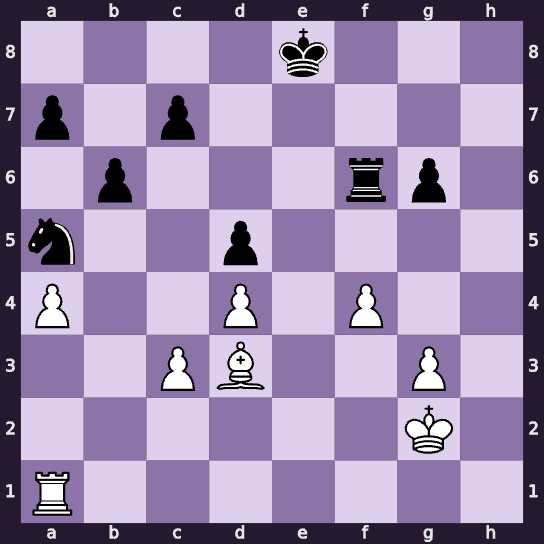
In the 1924 New York tournament, José Raúl Capablanca had White against Savielly Tartakower. Their completed game offers two decisions six moves apart. At the first position, queens are off the board. The h-file is open, White’s rook is on a1, and Black’s rook is on f6. The sample note below is a reconstruction written for this exercise. It represents a way to examine the position from White’s side.
- What changed
- Black’s h-pawn recaptured on g6. With both h-pawns gone from the file, I can put the rook on h1 and work up the board.
- Candidate A
- 29.Rh1. If 29…Kf8, I can try 30.Rh7 and threaten to take c7. If 30…Rc6, the rook on c6 keeps my rook from taking c7 safely and attacks my pawn on c3.
- Candidate B
- 29.Re1+. I get a check, but 29…Kf7 steps out of it and connects the king to the rook on f6. I can play 30.Re5 and attack d5. I still need to see whether Black can chase me away or defend.
- First-pass judgment
- I prefer Rh1. The destination on h7 gives the rook a job I can name. I need to keep track of c3 if Black’s rook switches to the c-file.
Notice how the note names a candidate that gives check, then makes Black respond. That is where you can compare the two plans. If you stop at Re1+, the check feels decisive because you have yet to move Black’s king. After Kf7, White still has ideas, but the game becomes about what the rook can do next.
There is also an unchecked assumption in the first note. It uses Kf8 as Black’s reply to Rh1. On your first pass, label it “the reply I checked.” Before settling on a verdict, try to find a Black move that contests the h-file or attacks somewhere with tempo. The target is a line you can challenge, with each side getting a say.
Play the two decisions without engine feedback
The first position lets you test the sample note. On the second board, White is about to move on turn 35. Each side has a rook and five pawns. White’s pawn on g5 is passed, Black’s rook has a clear path from c6 to c3, and White’s king starts on f3. Give yourself up to three minutes. Compare 35.g6 and 35.Kg3, find a reply to each, and write the white king’s next square before you open the check.
The board couldn’t load. You can use either diagram and write the moves on paper.
Play both sides
Choose any legal move for White, then choose Black’s reply. Use the arrow keys and Enter to play from the keyboard.
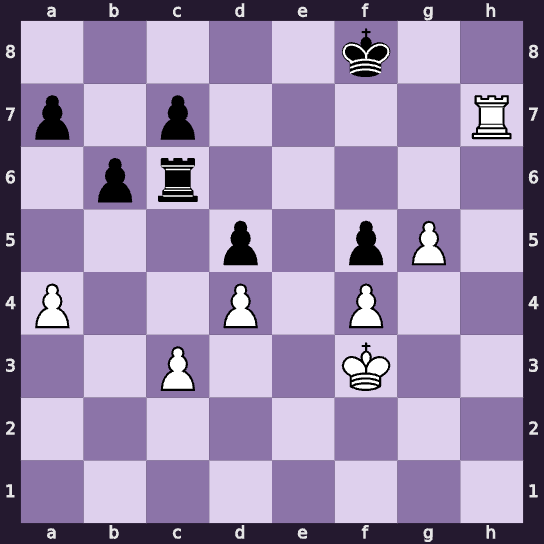
For each choice, answer these two questions on paper. Where is the black rook’s most intrusive square? Which white king move does that reply leave you? You can replay the rook reply on both boards before writing your assessment. If you find a different strong reply, record it too. The board reports legal moves only. It gives the same neutral feedback whichever candidate you play.
Copy the second position5k2/p1p4R/1pr5/3p1pP1/P2P1P2/2P2K2/8/8 w - - 0 35
Check the lines after you save your first pass
Compare your original note with the game continuation first, then look at the engine alternatives. Keep both versions in your notes. If you change your mind, identify the first move or square that changed it.
Reveal the played moves, Stockfish comparisons, and annotated correction
At move 29, check what the rook gains and what it leaves behind
The game continued 29.Rh1 Kf8 30.Rh7 Rc6. White’s rook reached the seventh rank and Black’s rook took up the job of defending c7. From c6 it also targeted c3. The first-pass note catches both effects. After 29.Re1+ Kf7 30.Re5, a checked continuation is 30…Rd6. The rook on d6 can defend d5 from behind. The initial check moved the king, but it did not decide the position.
Stockfish’s White-perspective estimates in this run were +0.76 for Rh1 and +0.15 for Re1+. The comparison supports the open-file idea in this position. The score alone says little about the next move. The board shows that Black can contest a pawn elsewhere while White’s rook is active.
At move 35, run the same rook check against both plans
Capablanca played 35.Kg3 Rxc3+ 36.Kh4. Black’s check helps send the king in the direction it wants to go. The played line continued 36…Rf3 37.g6 Rxf4+ 38.Kg5 Re4 39.Kf6. White has allowed the c3- and f4-pawns to fall. The king on f6 is now adjacent to the pawn on g6, and the rook on h7 is already active on the seventh rank. That is the placement Alekhine highlighted in the tournament book.
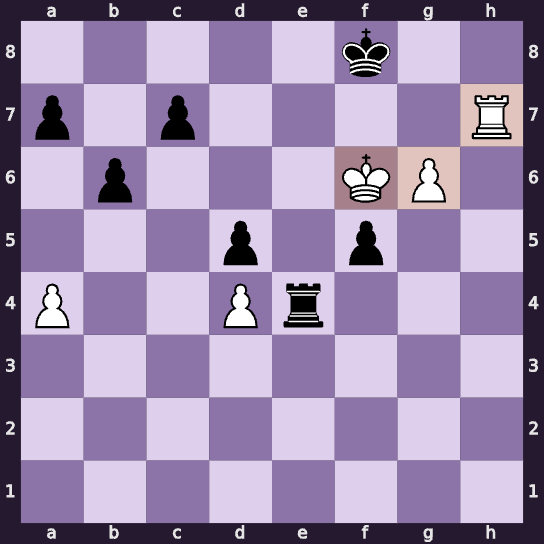
With 35.g6 Rxc3+, White’s king is still on f3. It cannot reach h4 in one move. One checked line is 36.Kf2 Rc6 37.Rf7+ Ke8 38.Rxf5 Rxg6. The rook returned from c3 to c6, where it could attack the pawn on g6 along the sixth rank. White’s king on f2 is too far away to defend it.
Test a quieter reply before deciding that the plan depends on a friendly check. In another checked line, 35.Kg3 a6 36.Kh4 Rxc3 37.Kh5, the rook captures on c3 without check. White continues toward the kingside anyway. This line separates the general plan of activating the king from the exact route it took in the game.
At the same search depth, Stockfish estimated +1.73 after selecting Kg3 and 0.00 for g6 from the same starting board. These are search estimates. For this review the decisive detail is visible without a number. The same check leaves the king on different routes, and that determines whether g6 arrives with support. Even in the Kg3 branch, a defender can choose a different reply. The played line illustrates the plan; it is one continuation.
- First-pass guess
- Push the passed pawn while the rook is active and try to queen quickly.
- Checked correction
- Rxc3+ changes the order. From f3 the king has no route straight to h4. From g3 it can go there immediately, then support g6.
- Question to keep
- Before I push a passed pawn in a rook ending, what is the opponent’s best check, and where does it send my king?
Game moves from Capablanca–Tartakower, New York 1924, round six. Capablanca won. The first-pass notes above were written for this exercise. The comparison scores come from Stockfish 19 depth-18 searches from White’s point of view. Each search used one allowed first move, one thread, and a cleared 64 MB hash. Tournament score and Alekhine’s published notes · Stockfish’s evaluation notes
How to set up a clean board for your own game
- Chess.com
- Use Self Analysis. The options beside Analysis control the evaluation bar, lines, suggestion arrows, and move feedback. If the game already shows review labels, use a plain PGN on a fresh board. Chess.com’s Self Analysis guide
- Lichess
- Paste the moves into an Analysis board and leave the local engine off. The Lichess guide lists L for toggling local evaluation. A new Study chapter gives you a place to save variations and comments. Lichess’s analysis and study controls
- Tera Chess
- Open the Analysis board, choose Position & PGN, then load a completed game. In Moves & lines, leave Analyze as I move and Best-move arrow unchecked. When you finish your notes, select Analyze position from the decision you want to check. Open the Analysis board
You can also use the paper notes beside a physical board. Record moves in algebraic notation or use coordinates such as “king f3 to g3.” The point is to be able to rebuild your line. If you played over the board and have a score sheet, enter the game once, save the unannotated PGN, and use a copy for review. Export a clean PGN from Chess.com
Turn a checked correction into one practice decision
Review the first note and circle the missing question. In the example, the gap is the king’s square after a rook check. In your game it might be a loose piece after an exchange or an escape square you thought was covered. Copy the position from before the decision and take the note out of view. The next day, replay the two candidates and see whether you can name the threat and show the reply without assistance.
Once you remember this game, choose a fresh position where the same question could matter. Try the question in a position where pushing the pawn immediately is actually sound. Checking a different board tests whether you can use the idea when you have to work out the answer. Record the original attempt and any later practice as separate entries. Try a mixed test without tactic labels
If the verification supports your first pass, write down the observation you want to keep. You might have recognized the open h-file or counted the checks correctly. You can build a review habit around sound decisions as well as mistakes. If the engine offers a stronger option you never considered, ask how you could find it next time. Add one cue to your notes and leave the rest of the game for later. Use the printable game review worksheet
A short schedule can make this manageable. Spend two minutes replaying, four on the two candidates, two writing your judgment and doubt, then two checking the biggest difference. If you only have five minutes, complete the first-pass note and leave the check for later. That note gives you a place to resume. Work through a timed blitz review
Questions about analyzing chess without an engine
Which moves should I annotate?
Start where two plausible choices lead to different positions or where an unexpected reply changed your plan. Before a trade, ask whose pieces improve after it. Before a pawn push, ask who can use the newly opened square. One position you can reconstruct is enough for your first session.
What if I already saw the evaluation?
Mark your note as a second pass. You can still explain the engine line in your own words or try a different decision whose evaluation you have yet to see. If you know the answer in both example positions, use a completed game you have never reviewed for your next first pass.
Can I finish the review without Stockfish?
Yes. Save the replies you found and any questions you could not settle. You can ask an opponent, club teammate, or coach to play the other side afterward. If you do check with an engine, return to the exact starting board and compare both candidates from the same point of view. Read the evaluation and reply together