A Chess Game Analysis Worksheet You Can Reuse
Record what you saw before the engine, then keep the checked reply and one question for practice.
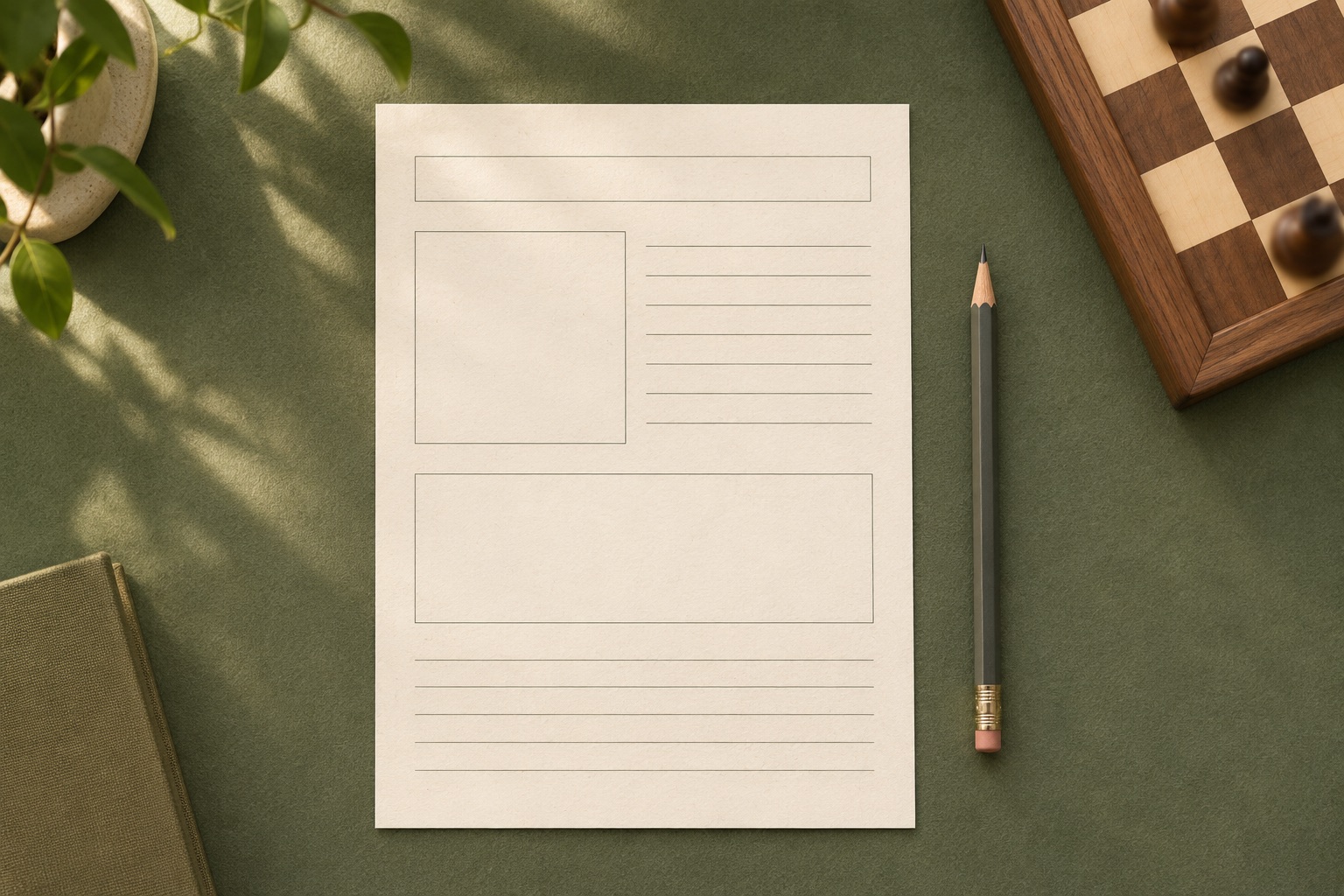
Use this chess game analysis worksheet to review one decision from a completed game. Write the move you played and the reply you expected before you switch on the engine. Then record the strongest reply you checked, compare one other move from the same position, and save a question for next time.
The PDF is one page. Choose Fit when printing it on US Letter paper, or use the plain-text version in any notes app. The worked example below shows how to fill each section without losing track of what you originally saw.
Fill in your own reasoning before checking the engine
Choose a position where you made a decision. An opponent’s surprising reply is a good starting point. So is a move you took a long time over, even if it turned out well. Use the game link or PGN filename and the move number to get back to that position. Stop on the board before your move. Write the side to play and the clock if the game record has it.
- Original move
- Write the move you played and what you wanted to happen. “Move the king away from the h-file” is a claim you can check.
- Expected reply
- Write the opponent move you remember considering. If you can’t recall one, write “unknown.” You can add your current guess on a new line and label when you made it.
- Another candidate
- Save one alternative you considered. If you first noticed it after the game, write “added in review” next to the move.
Take a minute to examine the board before you write. Trace the opponent’s last move from its starting square to where it landed. Did it open a diagonal, unguard a piece, or move the king? Record one concrete observation. If you want to criticize a move like Kg6, first find what attack it allows that the original king square avoided.
Keep the first section even if you already clicked Game Review. Write what you remember and label anything you saw on the review screen. The distinction gives you a record you can trust the next time you read it. If the game was too fast to remember the alternatives, the moves and clocks are still useful evidence. Review a blitz decision with the clock record
When you remember the plan but not the variation
Write the thing you were aiming for even if the exact reply is gone. For example, “I wanted to trade queens because their checks were hard to face” is worth keeping. You can then test whether your move actually offers a trade and whether the opponent can decline with a check. Put that newly discovered reply in the second section. If you later remember a different reason, add it with the date instead of replacing your first note.
Check both moves from the same starting position
Replay your original move. Find a reply that tests the plan you wrote down. If your plan was to stop a check, look for other checks. If you moved a defender, look at what it was guarding. Follow the reply until you can name the first concrete change that matters. You might reach a lost piece in one move or need several moves to see a forced mate.
Rewind to the same board and play your alternative. Look at the opponent’s strongest reply and then one move beyond it. Record what the alternative preserves or changes. For example, “The rook stays defended” is a better note than “The engine preferred it.” When both moves are sound, you can compare which reply you understand and which resulting position you’d rather play.
Some positions have a difference of a few decimal points between candidates. Focus on whether either line introduces a threat or changes your plan. If the engine finds mate after one move and a playable position after another, save the line that explains the gap. If the numbers change while the engine runs, compare the replies again. The worksheet can hold a checked line without requiring a final score. Read an evaluation or mate score
How much of the engine line belongs on the sheet?
Write enough moves to show the reason. If the opponent’s move wins an undefended bishop immediately, record that capture and what you changed to allow it. In a mating sequence, keep the line through the last check if the escape squares are part of what you missed. A reader should be able to tell from the moves where the first comparison ends. When two defensive replies tell different stories, save the one that surprised you in a side note.
A filled-in example from a completed game
In the July 1, 2025 game between DanielNaroditsky and bangchess21, Black had 21.2 seconds when White played 31.Kb3. Black chose 31…Kg6. The game and clock are public. The proposed thought and expected reply below are illustrations of how to fill in the worksheet. Source game on Chess.com
- Before checking
- 31…Kg6. Sample note: “I want to move away from h7. I looked at 32.Qxh5+ and thought 32…Kxh5 answered it.”
- Other move
- 31…Rb2+. Added in review. The e2-rook can check White’s king while Black’s king stays on h7.
- After checking
- 32.Qf6+ was the reply in the game. The queen can move to f6, where White’s bishop on d4 guards it. The checked game line ends in mate.
- Alternative reply
- 31…Rb2+ 32.Kc4 Rxa2. White has to answer the rook check. Black keeps the king on h7 and starts taking pawns with the rook.
- Next practice
- “Before I move my king, which checking squares does the opponent’s bishop protect?” Test the question on a different queen-and-bishop position.
Write down your own prediction before trying the board. For the first pass, look at the diagonal from d4 and ask where the queen could give check on the next move.
The board couldn’t load. The diagram and checked moves are below.
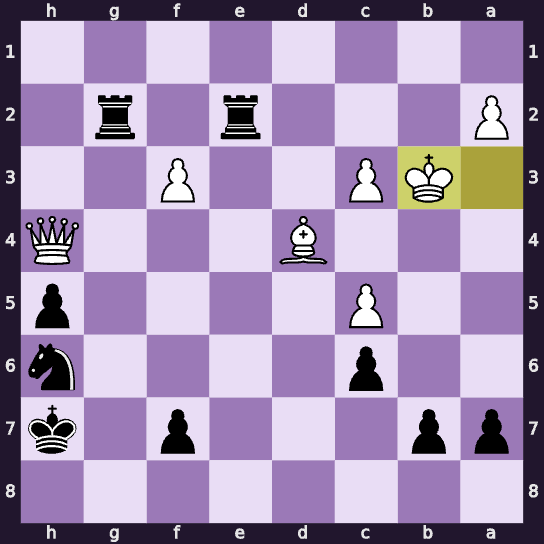
What checks does White have after Kg6?
Select a piece and destination or drag to move. With a keyboard, use the arrows and Enter.
Read the checked game line and alternative
After 31…Kg6, White could play 32.Qxh5+ Kxh5. Those moves are legal. The original prediction would still miss the strongest check. White played 32.Qf6+ Kh7 33.Qh8+ Kg6 34.Qg7+ Kf5 35.Qf6#. The bishop on d4 protects f6, g7, and h8, so the queen can use each square to keep checking.
From the same starting board, 31…Rb2+ 32.Kc4 Rxa2 keeps play going. With Black’s king on h7, the queen on f6 would not give check. On the …Rb2+ board, White also has to deal with the rook check immediately. Another checked option is 31…b5 32.c4 bxc4+ 33.Kxc4. Black keeps the king on h7 and challenges White’s queenside.
Stockfish 19 at depth 21 found a forced mate in four for White after Kg6 and assessed the position after Rb2+ as close to balanced in the checked line. All shown moves were checked for legality. The public board uses prepared replies.
Copy the starting position8/pp3p1k/2p4n/2P4p/3B3Q/1KP2P2/P3r1r1/8 b - - 3 31
Look at the change between the before and after sections. The original prediction imagined a queen capture on h5 and a king recapture. The real reply used a different square that the bishop defended. The practice question is about protected checking squares. It carries more information than “avoid Kg6.”
You can also use the example to check the quality of the alternative. Play Rb2+ and name White’s response before revealing Kc4. The point of comparing the lines is to see who has to respond and where the kings can go. A good worksheet records why you can play the alternative even if another legal move also works. If you thought of b5, follow that branch too and write how White’s c-pawn changes the position.
If you saw Qf6+ but thought Kh7 ended the danger, record exactly where your calculation stopped. The board then gives you a second question for a later session. After the king retreats, can the queen reach another square where the bishop protects it? Seeing the first check and following the king through the rest of the line are two distinct decisions you can practise.
Turn the checked reply into a practice question
A useful question names a situation and a thing to look for. “When the enemy queen and bishop point toward my king, which squares can the queen check from safely?” gives you a test. “Check more carefully” leaves the next decision just as open as before.
Redo the old position later with the answer covered. Write one candidate and one reply. That tells you whether you can recall the line. Use a different position to test the cue itself. Change which side attacks, or find a board where the obvious check can be answered by taking the queen. This keeps the exercise about seeing protection and legality on the new board.
If you’re reviewing several games, save one sheet per decision and look for the same question appearing more than once. If the game had no queen-and-bishop threat, that game tells you little about this particular habit. If the cue appeared and you noticed it before moving, write down when. You can then choose the next practice position from evidence you can reconstruct. Try a mixed test before seeing the answers
On your next practice sheet, write whether you saw the cue before moving, only after the reply, or never got a position where it applied. Include whether you used a hint. An unhinted first decision tells you something different from a retry. For an opening mistake, the cue might be an undefended piece after an exchange. For an ending, it might be an outside passed pawn that draws the king away. Use the same record of what you saw and when you saw it.
If you found yourself repeating the move you played, use the candidate-move worksheet to build a fresh shortlist from the same position.
Keep the same worksheet beside any analysis board
On Chess.com, you can save an analysis or export notes as part of an annotated PGN. Save a clean game record as well if you want to open it with the engine off next time. Lichess Study keeps comments and branches beside the moves and lets you choose who can see the study. In Tera Chess, load the completed PGN or the position FEN in the Analysis board, then play both candidates from the same move. Keep your original worksheet beside the checked lines. Save a Chess.com analysis · Lichess Study notes and variations · Compare three ways to review the same game
Name a saved note so you’ll find it again. A filename that contains the date, color, and move number is enough, such as 2025-07-01-black-m31.txt. Put the FEN inside if you want to reproduce the exact decision quickly. Save the whole PGN if the sequence leading to the position matters. Download a completed game as a PGN
If you review with a coach or training partner, share the starting board and your first section. Ask them to play the reply they would choose. Write down where their line differed from yours, then replay both from the starting position. When you compare notes first, you can test the exact assumption you made during the game.
Common questions about the worksheet
Can I use it without an engine?
Yes. Keep your predictions and try the replies on a board, then label the lines you’ve checked by hand. Ask a coach or use a later engine check when you want to test whether a stronger reply exists.
What if my move was sound?
Keep it and record why it works. Compare how the opponent can make each candidate difficult. A sheet that explains a good decision gives you a plan you can recognize again.