How Discovered Attacks Work in Chess
Open a line for one piece, give the moving piece a job of its own, and calculate the reply that could spoil both.

A discovered attack happens when you move one of your pieces out of the way and uncover an attack by your rook, bishop, or queen. If the uncovered piece attacks the king, it’s a discovered check. If the moving piece checks the king as well, it’s a double check, and the king itself has to move. Chess.com’s discovered attack examples · Chess.com’s double check reference
The piece that moves can decide whether the idea wins a queen or gives your opponent checkmate. On two boards below, you move the same knight to f6. By swapping Black’s king and queen, we change what the rook sees and which piece wins the queen. Then you can try the real game where Richard Réti offered his own queen to put the king on exactly the right square.
Find the line first, then choose where the blocker goes
Look beyond one of your own pieces. If that piece is the only thing between your rook, bishop, or queen and an enemy king or valuable target, you have a candidate for discovery. Trace the entire line. A bishop that clears the rook’s file has helped only if the rook can see the target after the bishop moves. A second blocker further down the file can shut the idea down.
- Name all three pieces and their squares. On Board A, the rook is on e1, the knight blocks on e4, and the target is the queen on e8. This gives you a line to calculate instead of a general idea about attacking the queen.
- Give the moving piece a job. Ask if it can check, capture, attack a second target, or protect the square where its partner will capture. The knight’s move to f6 checks the king and also protects e8. Both details matter if the black king steps onto f8.
- Read the position after the move from the opponent’s side. Can they capture the checking piece, block the line, move the target with a threat, or checkmate you first? Consider what the target can do if your move opens a line in both directions.
- Count from the final position. Include what your opponent can take back after you collect the target. A queen for a knight is still a win, though it’s a different result from winning a queen and keeping the knight. After a double check, count legal king moves before you plan the finish.
A knight that was blocking a file always clears that file when it jumps. A bishop can move along the very diagonal you want to uncover and leave it blocked. On your turn, test the actual destination instead of assuming any move from the starting square will do the job.
Play two matched discovered-attack positions
White moves first on all three boards. Boards A and B are constructed examples. Only Black’s king and queen trade places. Try Nf6+ on both, replay each position, then reset and try Ng5. Board C starts just before Réti’s queen offer. Each move button takes you to that point in the checked line.
The playable board couldn’t load. Use the diagrams and checked lines below.
The knight blocks the e-file. Where can it go with check?
Select a piece and destination or drag to move. With a keyboard, use the arrow keys and Enter.
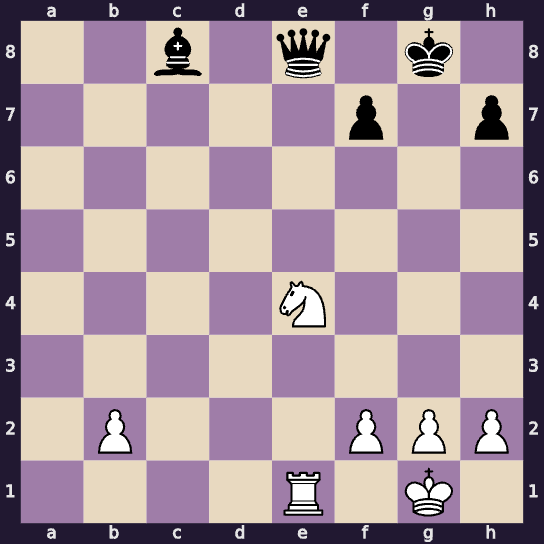
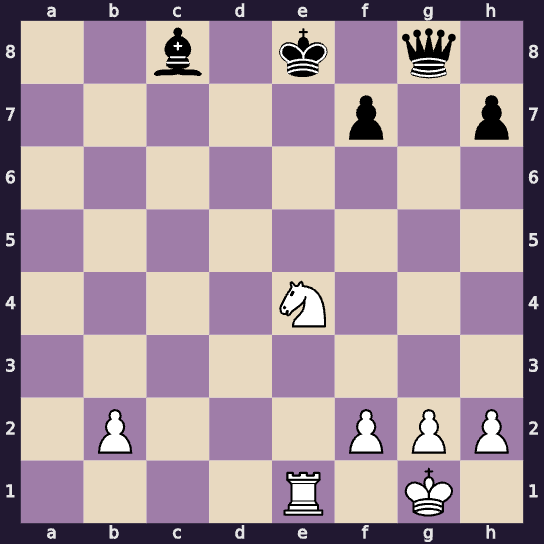
Board A · Open a line to the queen and check with the knight
Play 1.Nf6+. The knight attacks the king on g8 and the queen on e8. The rook attacks the queen from e1 along the file the knight just opened. Notice what the check buys White. Black’s queen could travel straight down the file and take the rook if it were free to move. That capture leaves the king in knight check, so it’s illegal here. Compare when an escape square actually saves the king
See all three king moves and why a quiet discovery loses
After 1…Kf8, try 2.Nxe8. The king is next to the knight on e8, but the rook on e1 protects it. White keeps both pieces in that line. After 1…Kg7, 2.Nxe8+ takes with check because the knight on e8 attacks g7. After 1…Kh8, 2.Rxe8+ Kg7 is another way to win the queen. The knight covers g8, but g7 is a legal escape square, so the rook capture gives check with a reply.
Compare 1.Ng5? Qxe1#. The rook still discovers an attack on the queen, but the knight gives no check from g5. The queen takes along the same open file, and White’s back rank has no escape. This is a discovered attack even though Black uses the line first.
For a quick calculation exercise, put White’s h2-pawn on h3 before playing Ng5. Now 1…Qxe1+ still takes the rook, but 2.Kh2 is legal. The attack on the queen, the queen’s capture, and the king’s escape are three separate things to verify. Creating a flight square changes mate into a material loss. Giving knight check in the original position prevents the capture entirely.
Board B · Make both pieces check, and keep the queen in reach
Play 1.Nf6+ again. The rook on e1 now attacks the king on e8 along the cleared file. The knight on f6 also attacks e8 and has a second target on g8. Black has only 1…Kd8 and 1…Kf8. Against 1…Kd8, play 2.Nxg8. The knight takes the queen from g8, where the king stood on Board A.
Against 1…Kf8, 2.Nxg8 Kxg8 trades a knight for a queen. If you want to look for more, try 2.Re8+ Kg7 3.Rxg8+, with the knight on f6 protecting the rook on e8 during the check. This is a good position to practise seeing both a clean material win and a forcing way to preserve the knight for longer.
Test a single check and a double check with the wrong target
1.Ng5+ is a discovered check here because the rook attacks the king. The knight on g5 doesn’t. Black can block with 1…Be6. Then 2.Nxe6 fxe6 trades a knight for a bishop and leaves the queen on the board. A single line check can allow a block.
1.Nd6+ is a genuine double check. The knight on d6 also attacks the king on e8, but now it can’t reach the queen on g8. One reply is 1…Kd7 2.Nxc8 Qxc8. White trades knight for bishop while Black keeps the queen. The number of checkers tells you about the replies. The knight’s landing square decides what it can collect after the king moves.
- Discovered attack
- On A, the rook discovers an attack on the queen. The knight itself gives the check.
- Discovered check
- On B after Ng5+, the rook alone checks on the newly open e-file.
- Double check
- On B after Nf6+, the rook and knight both attack e8. Even blocking the rook leaves the knight’s check in place.
Can you spot double check from the move notation?
Both examples use Nf6+. The plus sign tells you the move gives check, and the position tells you which pieces are checking. When you replay a PGN, stop after the move and work backward from the king. First check the piece that moved. Then trace the line through the square it vacated. On A, tracing back from g8 reveals the knight alone. On B, tracing back from e8 finds the same knight and the rook down the e-file. Use both tests before you spend time looking for a block.
Réti vs. Tartakower · Set up a double check before you play it
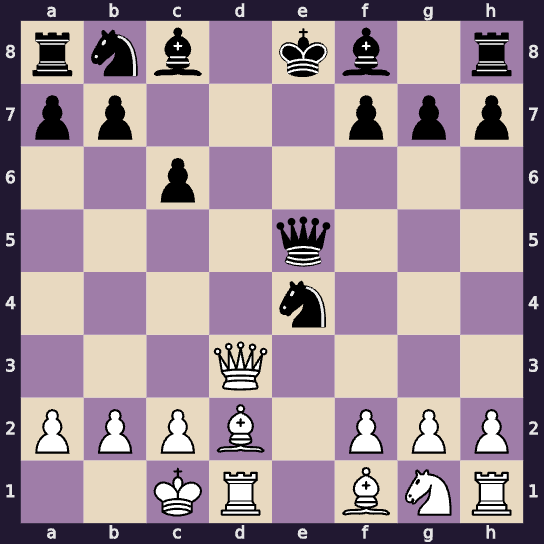
Switch to Board C. Réti’s rook is already on d1 after long castling, but his bishop on d2 and queen on d3 stand on the same file. Tartakower’s king is still on e8. The immediate 9.Bg5? gives no check. Black can play 9…Qxg5+ instead. To make the setup work, Réti needs to clear a square and move Black’s king in the same turn.
Replay the queen offer and calculate both mating replies
Play 9.Qd8+!. The queen leaves d3 with check, and 9…Kxd8 is Black’s only legal reply. Now 10.Bg5+ opens the d-file for the rook on d1. The bishop on g5 also checks along g5–f6–e7–d8. Black’s queen could reach g5 geometrically from e5 if the bishop were the only checker. Capturing it would leave the king in check from the rook.
In Tartakower’s published score, Black plays 10…Kc7. 11.Bd8# checks the king on c7 with the bishop, protected by the rook on d1. If Black returns to 10…Ke8, 11.Rd8# is mate with the rook, protected by the bishop on g5. The same two white pieces switch attacking and supporting roles depending on the king’s escape square. Edward Winter reproduces Tartakower’s score and also documents early reports that ended with resignation after 10.Bg5+. Historical sources for the game
The queen offer is justified because the setup is forced and both king moves end in mate. When you review your own games, look a turn earlier for a move that puts a king or loose piece on your rook’s line. Then calculate the opponent’s other replies. Réti could afford to give the queen away because there were exactly two continuations to finish calculating after the double check.
Download Réti–Tartakower with both mating lines
How the three examples were checked
Python-chess verified the moves, counted the checking pieces after Nf6+ on both matched boards, and enumerated the legal replies to Réti’s queen offer and double check. Stockfish 19 at depth 18 confirmed the wins after Nf6+ on both boards and found Black’s mate after 1.Ng5? on Board A. The mate lines finish in positions with zero legal replies.
How to stop a discovered attack
Start on the opponent’s turn in a position from a game you finished. Follow the rank, file, or diagonal from their long-range piece to your king or queen. If their own piece is the only blocker, test where it can move with check or with a capture. On Board A, Black would want to spot the knight’s move to f6 and the threat to e8 before White gets a turn. Looking only at what the knight threatens from e4 misses the rook entirely.
When you have a move to prepare, consider moving the target off the line, adding a second blocker, or changing where the moving piece can land. A pin sometimes keeps the blocker in place because moving it would expose its own king to check. Also check your forcing replies. On Board A, Black’s counterattack is stronger than the quiet discovery. Board B shows how a bishop can block a single check while leaving the queen safe. Practise identifying when a piece is pinned to its king
Once the double check is on the board, trace each possible king square. A king capture can answer double check when the square it lands on is safe from both checking pieces and all the other enemy pieces. In Réti’s finish, bringing the king to safety also requires seeing where the rook and bishop can deliver the next check and protect one another. That extra move matters more than how exposed the starting king looks.
Turn a missed discovery into a drill from your own game
Find a completed game where a rook attacked down a newly opened file, or where a knight moved with check and a different piece won material a move later. Stop before the first move. Write down the piece behind the blocker, the target on the line, and two destinations for the blocker. Play the opponent’s best reply to both. Use one final position to check whether the losing choice failed because you missed a check, missed a block, or miscounted the recapture.
If you found the move after seeing the tactic’s name, save a second position where several plans look reasonable. Put it in your review queue without a motif label. In that position, ask which line opens before you look for a knight check. Chess.com’s guide gives worked examples of discoveries, and Lichess offers a puzzle set devoted to the theme. Once you recognise it there, return to a mixed set or your own games, where nobody tells you to look for a discovery. Chess.com’s discovered checks · Lichess discovered attack puzzles · Practise finding tactics without a theme label