Why a High Accuracy Score Can Hide a Chess Mistake
Compare two completed games with similar scores, then replay the moves that tell a different story.

Chess accuracy is a game-review score that summarizes how closely your moves matched the engine’s preferences in the positions you actually played. A high score can coexist with a serious mistake. In one completed blitz win with 93.68 accuracy, White allowed a knight capture that set up a pin on the queen. In another win with 93.52 accuracy, a queen trade led to a roughly even ending. The next useful review question is different in each game.
Use the number to orient yourself, then replay the position. Below, you can compare the move played with a stronger reply, and see why a change of a fraction of an accuracy point tells you very little about which decision to practise.
What does a chess accuracy score measure?
Chess.com describes its 0–100 Accuracy score as a comparison between your moves and the engine’s preferred play against your opponent’s specific moves. Its current method is called CAPS2. Chess.com notes that the method changed from the earlier version while retaining the comparison with engine recommendations. A score of 94 does not mean you played the top engine move on 94 percent of your turns. Chess.com’s explanation of CAPS2
- Accuracy
- One summary for a player’s moves across a game. Different games ask the player to solve different positions.
- Evaluation
- An engine’s estimate of a particular position. Compare the estimate before your move with the one after it, using the same side’s point of view.
- Rating
- Your playing rating changes with rated results and the rating system’s estimates. Game Review also shows a separate estimate of performance for one game.
Use the evaluation when you want to know whether one move changed the board significantly. Use the game score when you want a broad summary of the review. Check the label before reading the number, especially when the review shows the accuracy score, a move evaluation and a performance rating on the same screen. Read Stockfish evaluations and mate scores · Chess.com’s Game Rating explanation
How to compare your scores over several games
Start with games of the same time control and from the same review tool. Keep the game length and one decision beside every score. If your next score is higher, check what actually changed. You might have faced fewer difficult choices, or you might have found a good reply in a position that used to trouble you. Replay the decision itself to tell the difference.
Be especially careful when comparing a game that ended early with one that reached an ending. The short game may have ended before you faced a trade or a defensive decision. If you want to improve at a specific task, keep a separate record of attempts at that task. For example, review the first queen trade in each of your last few completed games and ask whether you could explain the resulting position before looking at a line.
Why the same number can describe different games
Each game supplies its own questions. One might include an opening you know, several natural recaptures, and one move where an attack on your queen changes everything. Another might give you a long ending with two playable plans and no obvious forced move at the point you are reviewing. The game score compresses those choices into one number. The move list tells you what you had to solve.
On Lichess, the published method converts board evaluations into estimated chances to win and combines move accuracies using both a volatility-weighted mean and a harmonic mean. That is a different method from Chess.com’s CAPS2. If you import the same moves into two tools, keep the provider’s name beside the score. Use the actual board and a checked line to compare what the tools are pointing out. Lichess’s published accuracy method
Two real games, 0.16 accuracy points apart
Both examples are completed three-minute games without an increment, played by Hikaru Nakamura with White in July 2025. He won both by resignation. The scores are the White accuracy values returned in the public Chess.com archive. The move estimates in the article come from a separate Stockfish run, so you can check the chess without guessing how CAPS2 combined the moves.
- 93.68
- Hikaru vs. Obito24, July 19, 27 moves. Before move 22, White could develop the bishop with Be3. Bg5 gave Black a tactical reply that was available immediately. See the completed game
- 93.52
- Hikaru vs. ChessMaster2011_1, July 18, 42 moves. On move 33, White exchanged queens and kept an active rook and both bishops. A bishop capture on the same square kept more pressure in the engine check. See the completed game
These are two examples selected to show different review questions. They share the player, color, time control and result. They have different opponents, game lengths and positions. The small gap between the two scores gives a reason to look more closely at the exact moves. Public archive with both scores and PGNs
The clocks add context. The archived PGNs show 5.1 seconds spent on Bg5 and 1.5 seconds spent on Qxe5, measured between consecutive White clock stamps. White had 2:21.1 and 1:28.7 left afterward. Those are records of time used. To understand what each brief decision allowed, you still have to play Black’s reply. In your own review, note what you remember considering before you infer that a move was rushed.
Play the moves behind both scores
Start with White before move 22 and decide where the bishop on c1 belongs. Then switch to Black after Bg5 and look for the strongest capture. On the last board, play White in the other game and compare two ways of taking the e5-pawn. The middle board puts Black at the bottom so you can work through the reply from the correct side.
The board couldn’t load. The diagrams and checked lines below show the moves.
How would you develop the bishop on c1?
Select a piece and destination or drag to move. With a keyboard, use the arrows and Enter.
93.68 accuracy · One bishop move allowed a pin
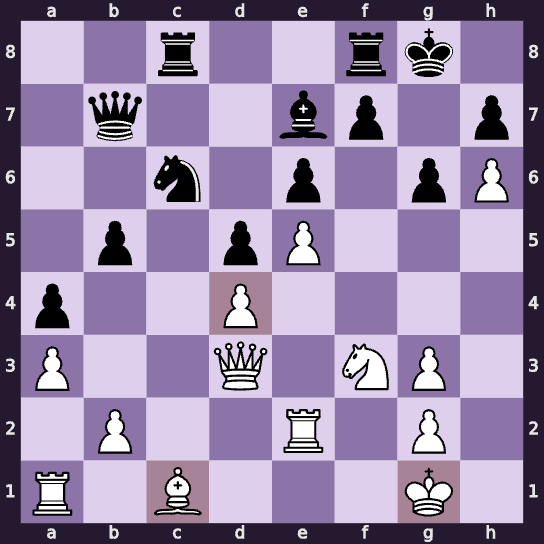
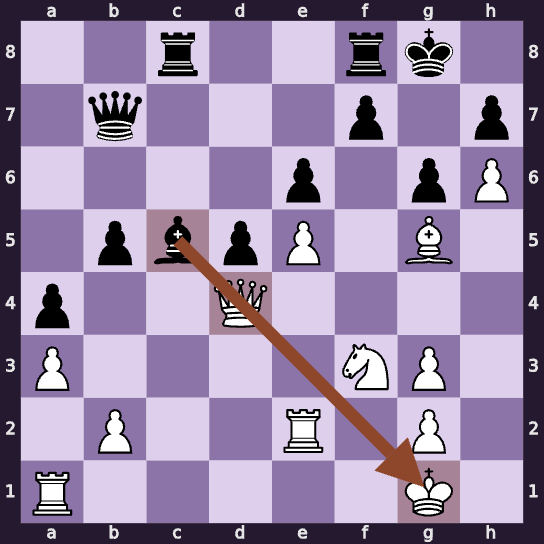
White played 22.Bg5. The bishop attacks Black’s bishop on e7, but Black can look at the center before answering. In the checked line, 22…Nxd4 23.Qxd4 Bc5, Black’s knight takes on d4 and leaves the c-file. After White’s queen recaptures on d4, Black’s bishop attacks it along c5–d4–e3–f2–g1. Moving the queen off that diagonal would expose the king to check.
The black rook on c8 can take back on c5 because c7 and c6 are clear. In the checked continuation 24.Qxc5 Rxc5, White trades the queen for the bishop. The knight capture’s purpose goes beyond taking a pawn. It opens the file for the rook and draws the queen to the square where the bishop can pin it. Stop after each of those moves and verify both the diagonal and the file.
Try 22.Be3 from the starting board. The bishop develops while defending d4. In one checked line, 22…Na5 23.Rf2, White still has choices and the queen remains on d3. In the actual game Black answered Bg5 with 22…Bxg5 23.Nxg5, so the pin never occurred. White later doubled rooks on the f-file and Black resigned after 27.Rdf1. The result explains what happened. The unplayed reply explains what Bg5 allowed.
93.52 accuracy · A queen trade changed the plan
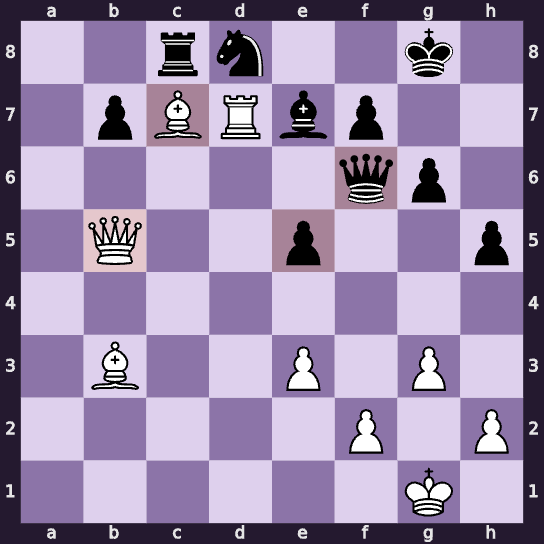
White actually played 33.Qxe5 Qxe5 34.Bxe5. The queens came off, leaving White with a rook and both bishops. The rook stayed on d7, while Black retained a rook, bishop and knight. In a separate check the position immediately after the trade evaluated close to even. That is a useful board to review if you want to practise playing with an active rook through a simplification.
The other capture 33.Bxe5 attacks the queen on f6 and gave White a larger advantage in the separate search. One line goes 33…Qc6 34.Qxc6 Nxc6 35.Bd5. In this branch the queens can still come off, but Black’s knight ends up on c6, and the white bishop from b3 reaches d5. Compare the two endings before you decide which continuation you would choose. Keep the engine preference and the practical reason for a trade in the same note.
The played trade still left work to do. In the real game White eventually checked with 41.Rxb7+ Kf8 42.Bh6+, and Black resigned. That later sequence does not tell you whether the earlier trade was the strongest move. It does give you a distinct thing to review. Watch how White maintained the rook on the seventh rank until it could take with check.
See the independent Stockfish checks
- Before White’s 22nd move
- Be3 +0.69, Bg5 −4.67. The played move permits the knight and bishop tactic.
- After Bg5, Black to move
- Nxd4 −4.27, Bxg5 +0.93. The first is the missed chance and the second was played.
- Before White’s 33rd move
- Qxe5 +0.14, Bxe5 +1.25. The queen trade leaves a playable ending. The bishop capture keeps more pressure in this search.
All values are from White’s point of view. Each candidate was checked using Stockfish 19 at depth 18 with one allowed root move, one thread and a cleared 64 MB hash. Compare candidates from the same board. These estimates describe positions and come from a different calculation than the archived Chess.com game scores. Stockfish’s notes on evaluating positions
When you compare engine outputs, start with the same FEN, same side to move, and comparable search settings. If the numeric gap changes on a deeper run, check whether the line still makes its point. The pin in the first example is visible through the legal moves. The preference between two queen trades can depend on what the engine finds several moves later.
Copy the position before 22.Bg52r2rk1/1q2bp1p/2n1p1pP/1p1pP3/p2P4/P2Q1NP1/1P2R1P1/R1B3K1 w - - 0 22
Copy the position before 33.Qxe52rn2k1/1pBRbp2/5qp1/1Q2p2p/8/1B2P1P1/5P1P/6K1 w - - 13 33
What to do the next time you see a high score
- Keep the score in the header. Record the source, result and time control. If you are following your own games over time, compare games reviewed on the same platform at similar time controls.
- Find one position where your options changed. Look for a large move-level shift, a move you made without seeing a reply, or a time you hesitated between plans. Open the board before that decision.
- Compare the played move with another move. Give the opponent the strongest reply you can find to both. If a line ends with a lost queen, keep the square and the reason. If two lines are playable, write what changes in the resulting position and which plan you would prefer.
- Save a question for the next game. “Will moving my bishop leave a queen vulnerable to a pin?” leads to a board check you can repeat. “Was I 94 or 95?” leaves the position out of the review.
For the first example, save the board before Bg5 under a neutral name. Then spend one separate practice attempt on Black’s reply after Bg5. The test is whether you can reconstruct why the rook on c8 matters. For the second example, set up the position after each queen trade and name a plan for your least active piece before looking at another engine line. Practise a reply your opponent missed in a game you won · Use the printable review worksheet
If most of your games have similar scores, use the notes to see which decisions recur. Two misses involving the same attacking diagonal tell you what to test next. Retrying the same board will test recall after the first review. Use a fresh position with an unlabeled threat to see whether you can find the idea without recognizing the answer. Try a mixed set without tactic labels
Which review tool should I use?
- Chess.com
- Use Game Review for the original accuracy score, evaluation graph and move classifications. Use Self Analysis when you want to rewind and try a different reply. Chess.com Game Review guide
- Lichess
- Use computer analysis for the game graph and Lichess’s own accuracy measure. A Study lets you keep alternate lines and comments beside the game. Lichess accuracy guide
- Tera Chess
- Load a completed game in the Analysis board, rewind to the move, and compare the legal candidates and engine lines. You can also train positions found in your own completed games. Open the Analysis board
Common questions about chess accuracy scores
Is 90 a good chess accuracy score?
It is toward the high end of the 50–95 range Chess.com reports for most scores. Its usefulness depends on the positions in that game, the time control and the review’s method. A long defensive game with difficult choices can give you a more instructive review than a higher score in a short familiar opening.
Can I lose with high accuracy?
Yes. The final result depends on the position that was reached, how the game ended and whether the opponent took their chances. Look for the position where you still had a different decision. A single mistake can be costly in a game where most of your moves held up.
Does high accuracy show cheating?
A single game’s accuracy score cannot establish that. Chess.com treats Accuracy as a review feature and uses a separate fair play process. Use the number to investigate your chess decisions. Chess.com’s fair play explanation